

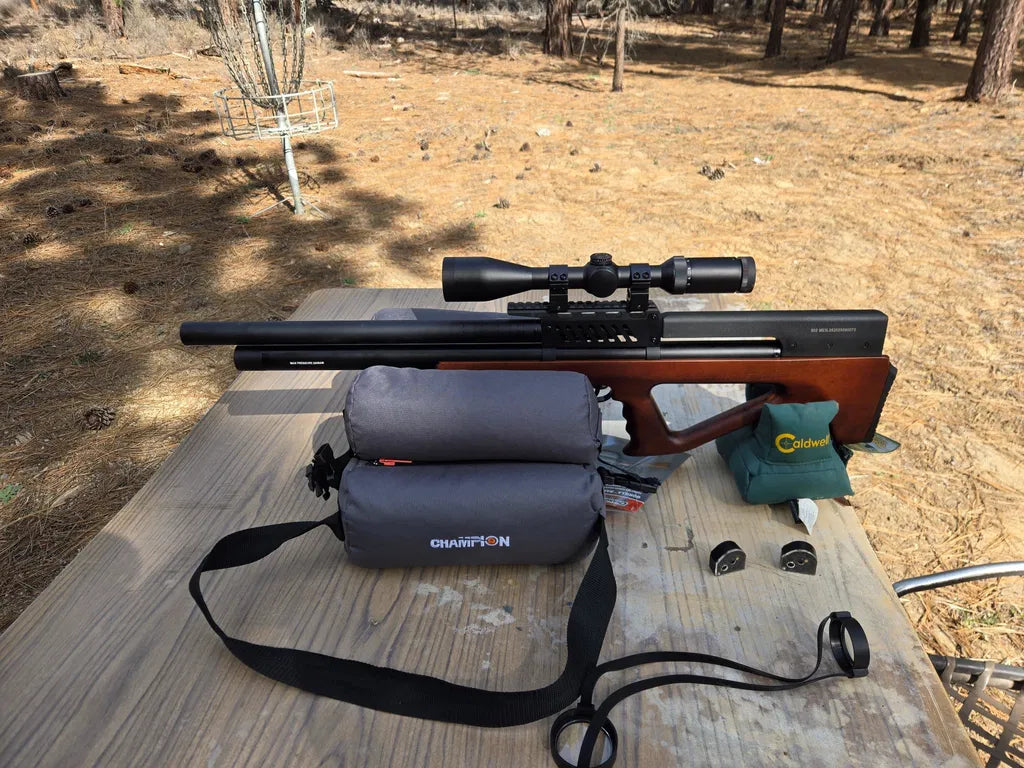
Your .25 PCP is only as accurate as the pellet you feed it. Put a 25.39-grain dome in a rifle that wants a 34-grain slug, and the groups open up at distance. Go the other way—a heavy pellet in a platform that can't push it past 650 FPS—and the trajectory starts looking like a rainbow. The rifle isn't the problem. The pellet weight is.
This guide breaks down how .25 caliber pellet weight affects ballistic coefficient, trajectory, and wind drift at 50 and 100 yards, and how to match a pellet to a PCP air rifle without guessing.
Why .25 Caliber Is More Weight-Sensitive Than .22
A .25 PCP typically shoots pellets between 25 and 34 grains, with muzzle energy landing somewhere in the 45 to 70+ ft-lb range. That weight window is wide enough that pellet choice actually changes how the rifle behaves, not just how fast the chronograph reads.
The reason comes down to sectional density. A heavier .25 pellet in the same diameter has more mass behind the same frontal area. That generally produces a higher ballistic coefficient (BC), which means the pellet holds velocity better and drifts less in the wind. In .22, that effect is present but less pronounced. In .25, the gap between a mid-weight and a heavy pellet is large enough that it becomes a tuning decision, not just a preference.
The trade-off is air. A regulated .25 doesn't have an unlimited supply. Pick a pellet the platform can't push efficiently, and shot count drops along with consistency.

How Pellet Weight Changes BC and Wind Drift
BC measures how well a projectile overcomes air resistance. In the same caliber and general nose shape, a heavier pellet usually wins on BC because the mass increase outweighs the velocity loss.
Here are the working numbers for the two .25 pellets that come up most often:
JSB Exact King
25.39 gr
BC around .036–.038 depending on the test and velocity. A community chronograph comparison landed at .037, and a separate BC chart lists .036 for the same pellet.
JSB Exact King Heavy
33.95 gr
BC roughly .041–.046. The King Heavy came in at .041 in the same community test, and the MKII version is listed at .046 at lower velocity.
That gap looks small on paper. At 100 yards it isn't. A few thousandths of BC difference gets multiplied by a longer flight time, and the result shows up as more horizontal drift when the wind is doing anything other than sitting still.
But higher BC doesn't automatically mean "shoot the heaviest pellet you can find." A 34-grain .25 pellet only helps at distance if the rifle can launch it with a tight velocity spread. If a PCP air rifle can only manage 620–650 FPS with a 34-grain dome, the trajectory gets loopy enough that the BC advantage is eaten by holdover error at 50 yards. The first rule of .25 pellet selection is whether the platform can push the weight consistently, not whether the BC number looks better on a chart.

50 Yards: 25.39 Grains Is the Low-Risk Starting Point
At 50 yards, a 25.39-grain dome does several things well for a .25 PCP.
It leaves more velocity headroom. A regulated rifle that pushes a 25.39-grain pellet to 850–900 FPS gives a relatively flat trajectory inside 50 yards, which means less holdover guessing on targets or small game. It's also easier on shot count. Lighter pellets use less air per shot, and on a regulated platform with a finite reservoir, that usually translates to more usable shots before the velocity falls off the regulator.
The third advantage is data. More shooters and testers have published chronograph and group data on 25.39-grain .25 pellets than on any other weight. That makes it a safer baseline if you're trying to establish what a rifle can do before changing variables.
If your rifle can push a 25.39-grain pellet past 850 FPS with a single-digit standard deviation, you already have a workable 50-yard pellet for precision or small-game hunting. It doesn't mean that pellet is perfect for every barrel. It means you have a reference point.
100 Yards: When Heavier Pellets Start to Earn Their Keep
At 100 yards, the logic shifts.
Flight time gets long enough that wind drift becomes the dominant source of error. A 33–34-grain .25 pellet with a BC in the low-to-mid .040s resists that drift better than a 25-grain pellet, and it also retains more energy downrange. For 100-yard steel or longer-range pest control, that can make the difference between a predictable hold and a group that keeps sliding sideways.
The condition is velocity stability. A heavy pellet only helps if the rifle can launch it without a large extreme spread. If a 34-grain pellet produces a standard deviation twice as large as a 25.39-grain pellet in the same rifle, the BC advantage is being offset by inconsistent launch speed. In that case, the lighter pellet is still the better precision choice, even at distance.
One documented community field report gives a useful reference point: with a 25.4-grain .25 pellet leaving the barrel around 895 FPS and a 50-yard zero, the drop at 100 yards came out to roughly 12.3 inches. That number isn't a universal trajectory table. It's a reminder that 50-yard logic doesn't transfer directly to 100 yards. The curve is already doing real work by the time the pellet reaches the longer distance.

If You're Shooting N50, Pellet Weight Has a Rulebook Dimension
N50's Pellet Rifle class is one of the few organized benchrest formats where a .25 PCP can walk in without a caliber debate. The published rules allow any commercial Diabolo pellet design in .177, .22, .25, and .30 caliber, with a 100 ft-lb maximum, at 50 yards and 20 minutes per target. A .25 PCP shooting a 25.39-grain pellet at 42–44 ft-lbs is comfortably inside that ceiling.
That means the question at an N50 match isn't "is .25 legal?" It is. The question is which pellet weight gives the most repeatable group at 50 yards.
A regulated .25 that holds a tight standard deviation with a 25.39-grain pellet is already in a good place for N50 Pellet class. Chasing a heavier pellet for the BC gain only makes sense if the rifle can maintain that consistency with the heavier weight. If the standard deviation opens up, the BC advantage is irrelevant at 50 yards. In a scored benchrest match, a pellet that goes where it went last time beats a pellet that drifts less in theory but lands in a wider pattern.
Platform Matching: The Last Step Is Always Testing
Every .25 pellet weight discussion eventually runs into the same wall: the rifle decides what it likes.
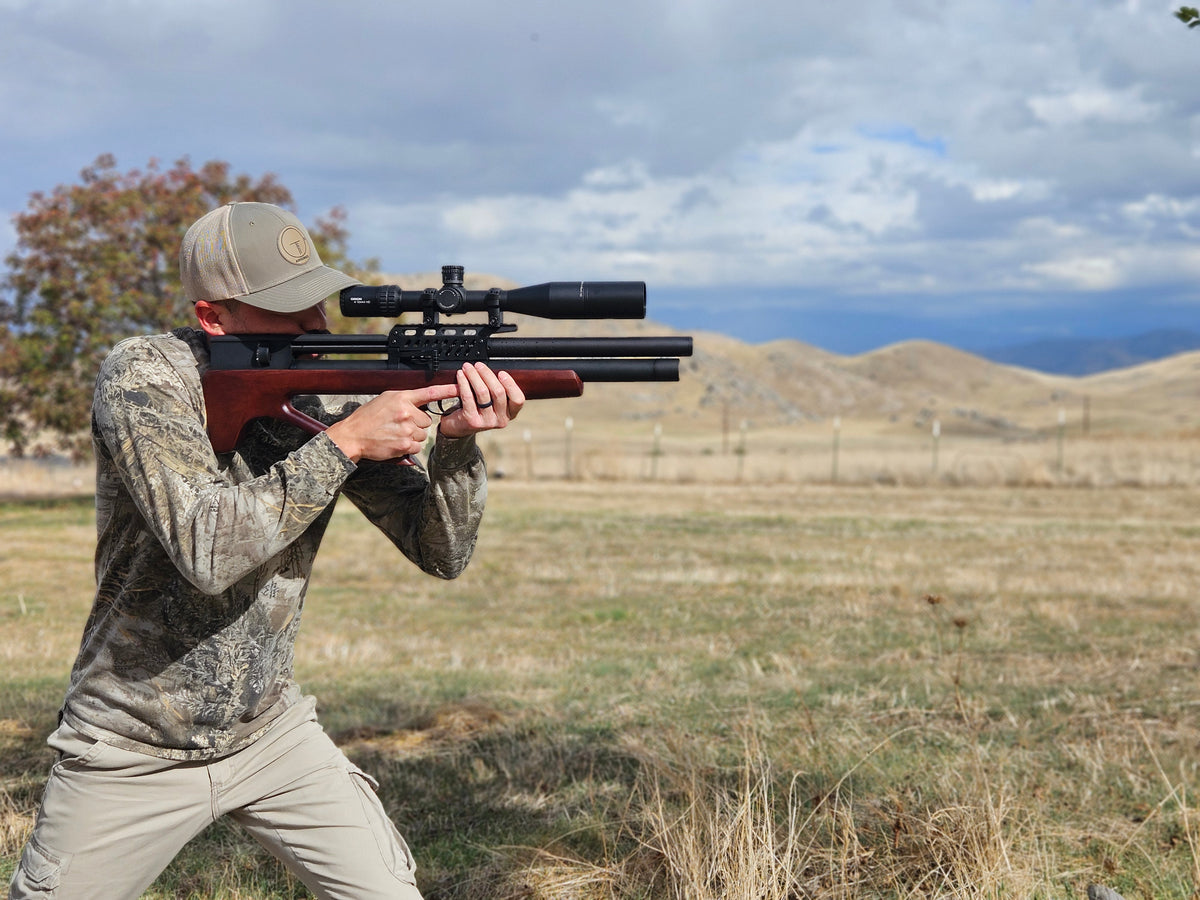
Valve design, regulator setting, barrel length, and twist rate all influence which pellet weight a given PCP air rifle handles well. A 34-grain dome that shoots beautifully in a long-barreled, high-power .25 may be a poor fit in a compact regulated bullpup that can't push it past 650 FPS.
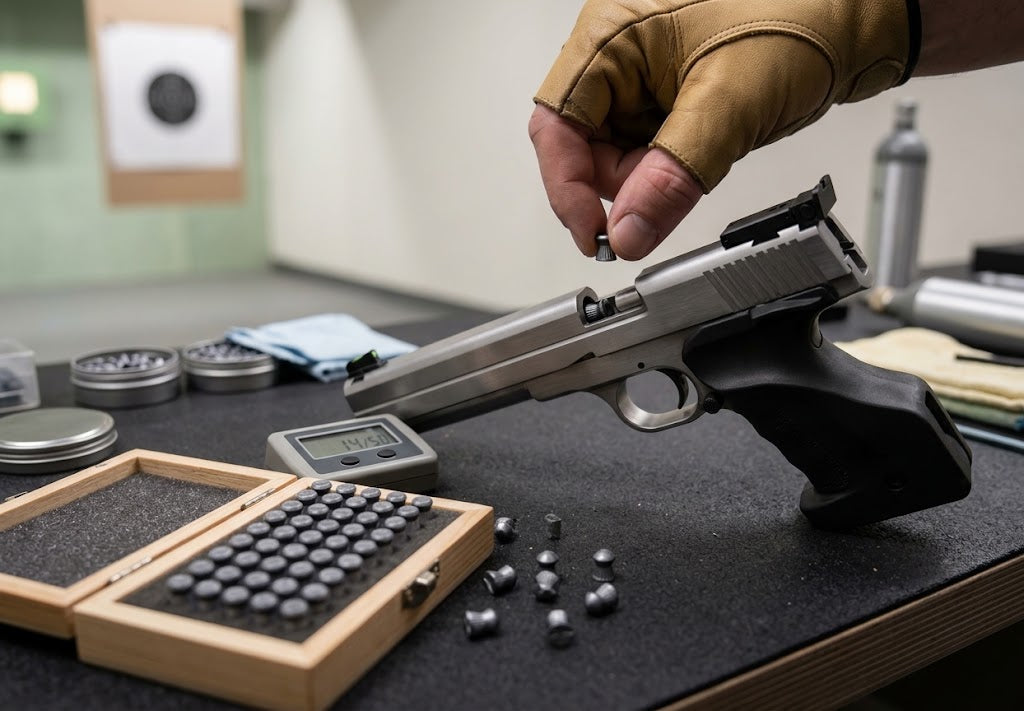
A simple testing sequence for .25 pellet selection:
01
Start with 25.39 grains. Record average velocity and standard deviation over at least 10 shots. If the average is above 850 FPS and the standard deviation stays under 10 FPS, you have a usable precision baseline.
02
Then test 33–34 grains. Watch the standard deviation more than the raw velocity. If the SD grows noticeably, the platform isn't regulating the heavier pellet cleanly enough for the BC advantage to matter at 100 yards.
03
Pick the heaviest pellet that still holds a tight standard deviation. That's the practical compromise between repeatability and wind resistance for a .25 PCP.

What a Real .25 Platform Looks Like in Chronograph Data
A concrete example helps here. Pinty tested the .25-caliber Striker with JSB Exact King 25-grain pellets and recorded 889 FPS average, 44 ft-lbs, 31 regulated shots, and a 4.9 FPS standard deviation. A separate Pinty test with JTS Dead Center 25.39-grain pellets averaged around 865 FPS and 42 ft-lbs, and a third Pinty review using JSB Diablo Exact 25.39-grain pellets delivered tight groups at 150 feet.
Those numbers are useful not because they prove the Striker is a dedicated benchrest rifle, but because they show what a consistent 25.39-grain baseline looks like on a regulated budget PCP. A 4.9 FPS standard deviation is tight for any rifle in this price range. It means the platform is regulating the 25-grain class of pellets cleanly enough that the shooter can focus on wind and position instead of chasing velocity swings.
If you want to try 33–34-grain pellets in a rifle like this, the first step isn't buying a tin. It's running a chronograph string and checking whether the heavier pellet holds a similar standard deviation. The 25.39-grain data gives you a reference. The heavy-pellet answer has to come from your own barrel.
The Short Version
- At 50 yards, 25.39 grains is the lowest-risk precision starting point for most regulated .25 PCPs.
- At 100 yards, 33–34 grains can make sense, but only if the rifle can push them with a tight standard deviation.
- In N50 or any scored benchrest format, consistency beats BC. A pellet with a wider velocity spread is a liability, no matter what the ballistic chart says.
- .25 caliber gives you a wide weight window. The pellet that actually works is the one your rifle can send through the same hole twice.
If you're tuning a Pinty Striker .25 for precision work, the chronograph and shot-count data from the Striker .25 review gives you a baseline to compare against your own numbers. The full platform specs and regulated shot count are on the Striker .25 product page, and if you're still deciding between calibers, the .177 vs .22 vs .25 caliber guide lays out where .25 fits in terms of energy, pellet weight, and practical use.




Share:
What 100-Yard Airgun Competitions Teach Us About Pellets