

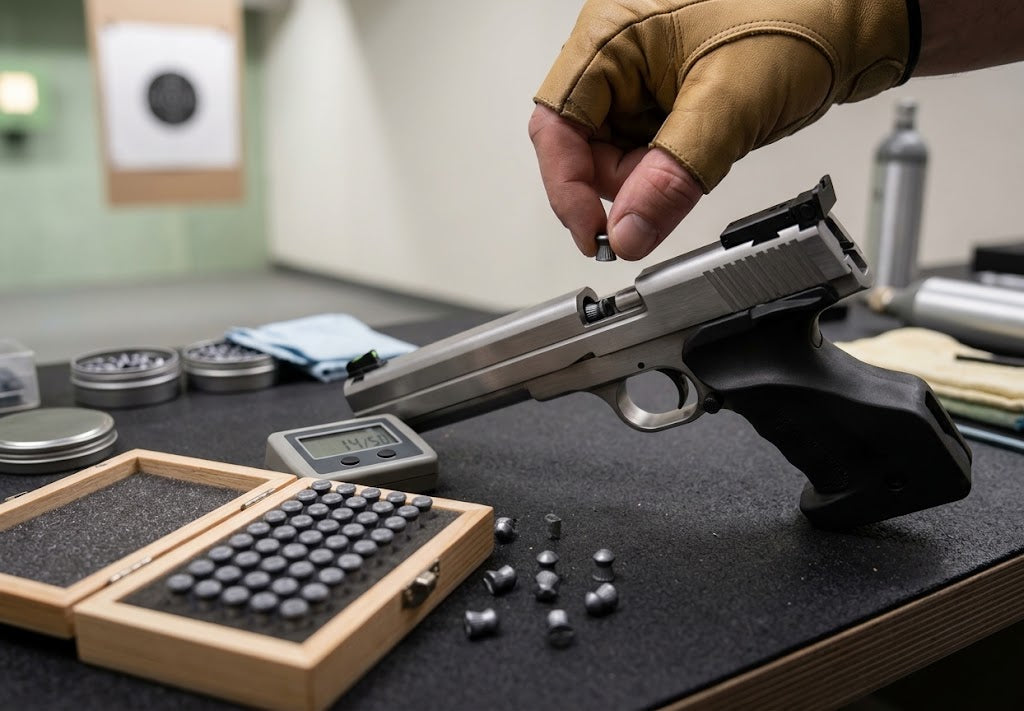
If you've recently started paying attention to 10-meter airgun competition, or even if you just want cleaner holes in your paper targets, you've probably run into the term wadcutter. These flat-nosed pellets tend to catch the eye because they look "less aerodynamic" than everything else on the shelf. But why are they the standard in competition? And more importantly, is this one of the pellets your Pinty airgun could possibly be shooting?
The flat head isn't for looks. It's for scoring.
Let's start with the obvious question: why are match pellets almost always flat-headed?
The answer is on the target paper. When a wadcutter passes through paper, its edge cuts a clean, circular hole like a hole punch. The boundary is sharp, and a judge can call the score at a glance.
A domed pellet tends to tear the paper, leaving a ragged, ambiguous hole. In 10-meter airgun competition, where the difference between one ring and the next can be smaller than the pellet itself, that ambiguity is fatal.
But the flat head is more than a scoring convenience. The deeper reason is in the rulebook.
Under the ISSF (International Shooting Sport Federation) regulations, 10-meter air rifle and 10-meter air pistol competitions require .177 caliber (4.5mm) flat-headed pellets. So, the flat head isn't just a manufacturer's marketing choice: it's a hard rule. If you want to shoot a sanctioned 10-meter match, a wadcutter is your entry ticket.

Match grade vs. standard grade: the real dividing line is tolerance
The flat head is only the outside. What actually makes match pellets "worth the money" is manufacturing tolerance.
China's national standard for airgun pellets (GB/T 28800) is a useful reference here. It specifies that for 4.5mm match-grade pellets, head diameter deviation must be held within ±0.005mm.
Head diameter directly determines how consistently a pellet engages the rifling: the tighter the tolerance, the more uniform the friction and spin rate from shot to shot, and the lower the extreme spread in muzzle velocity.
That last number is spelled out in the same standard: for match-grade pellets, the extreme spread of muzzle velocity across a test string must not exceed 8 m/s, compared with 28 m/s allowed for standard-grade pellets. That's a difference of more than threefold, and it's the single most concrete way to understand what "match grade" actually buys you.
Extreme spread of muzzle velocity
The practical question for Pinty shooters: does your gun need match pellets?
This is the part that matters most. The flathead pellet is not necessarily the pellet for a Pinty Airgun. In fact, in some cases, match pellets can actually make your Pinty airgun shoot worse.
Here's why: it all comes down to the design of match pellets. They are not very compatible with the design of the Pinty Airgun. Match pellets are designed around low muzzle velocity and short distance. Ten-meter airguns typically run in the 550–700 FPS range, with pellet weights around 0.50–0.56g (roughly 7.7–8.6 grains).
A flat head has a low ballistic coefficient by design; beyond roughly 20–25 yards, its dispersion grows noticeably. That's physics, not a defect.
Pinty's main PCPs (the Vanguard, Nightfall MKII, and Buster) are built for multi-purpose use: hunting, plinking, and medium-range precision. Their muzzle velocities sit well above the match-gun range.

Take the Vanguard .177: factory spec is 970 FPS with 8.18-grain pellets, and users report around 850 FPS with 10.5-grain pellets. If you feed it a light match wadcutter in the 8-grain range, you may push muzzle velocity past 900 FPS, approaching the sound barrier. In the transonic region, pellet stability degrades sharply — groups can open up, and in some cases pellets begin to keyhole.
The airgun community's practical consensus reflects this: wadcutters tend to perform best at lower velocities and lose grouping ability past roughly 25 yards. That's exactly the regime a high-velocity Pinty PCP is not in, unless you tune it down.
A more practical choice for most Pinty shooters is a mid-weight domed pellet. Vanguard users report 10.5-grain domed pellets grouping around 3/4 inch at 50 yards at roughly 850 FPS. The Nightfall MKII is spec'd at 940 FPS with 18.13-grain pellets — that weight range is where Pinty barrels and regulators tend to "digest" well.
One exception worth testing: both the Vanguard and the Buster have an adjustable hammer spring. If you dial the velocity down into the low-600s FPS, a flat-headed pellet becomes worth trying. Buster owners have reported dropping velocity into the 415–430 FPS range with a weaker hammer spring for 10-yard paper practice — and at that speed, the clean-hole advantage of a wadcutter finally shows up.
When match pellets make sense
Match-grade flat-heads (H&N Match Light 4.49mm, RWS R10, and similar) are worth considering if you meet these conditions:
- Your shooting distance is 10–20 yards, primarily on paper
- You can keep muzzle velocity low: roughly 600 FPS or below
- You care about clean, readable pellet holes more than downrange energy
Otherwise, put your money into mid-weight domed pellets that match your barrel, tune your regulator pressure, and work on trigger control. The accuracy potential in Pinty PCP airguns is bigger than most owners give it credit for.

A note on sourcing: The head-diameter tolerance (±0.005mm) and muzzle-velocity extreme spread (≤8 m/s for match, ≤28 m/s for standard) cited above come from China's national airgun pellet standard (GB/T 28800) and align with ISSF competition requirements. The velocity ranges for wadcutter performance are based on community experience, not a hard standard — every barrel is different, and the only way to know what your rifle likes is to test it yourself.




Share:
Pinty Airguns Explained: PCP Pistol vs Bullpup vs Rifle Guide
What 100-Yard Airgun Competitions Teach Us About Pellets