

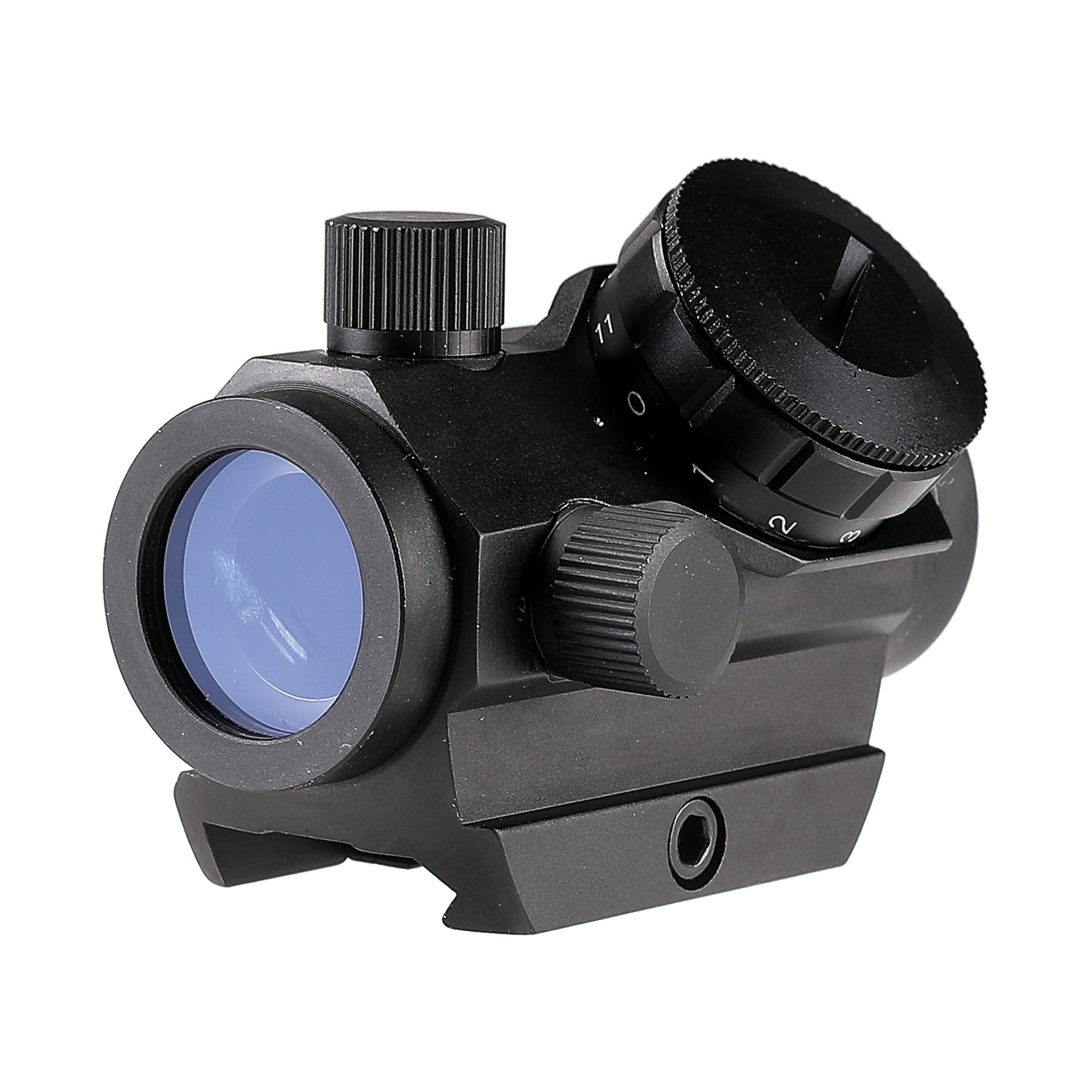
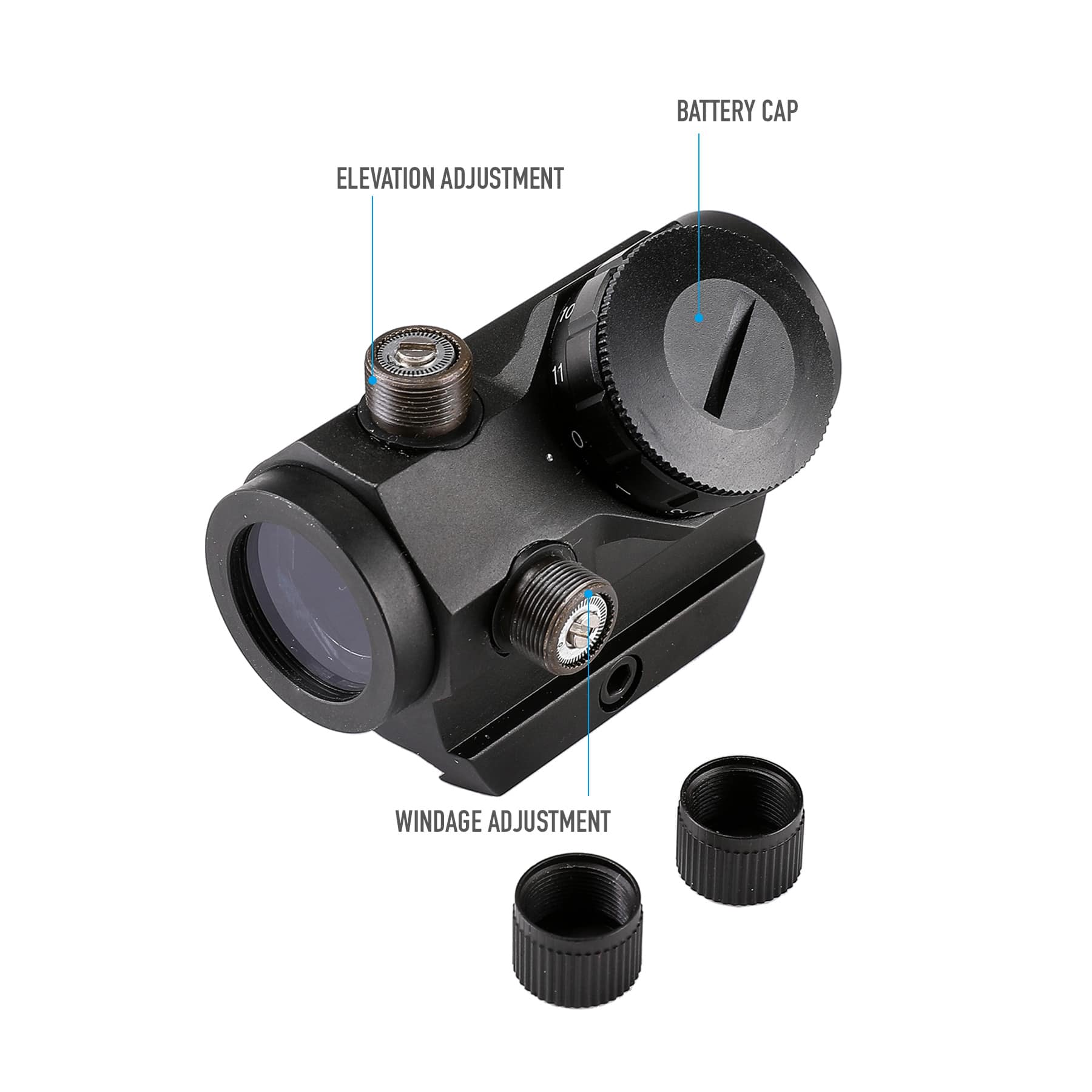
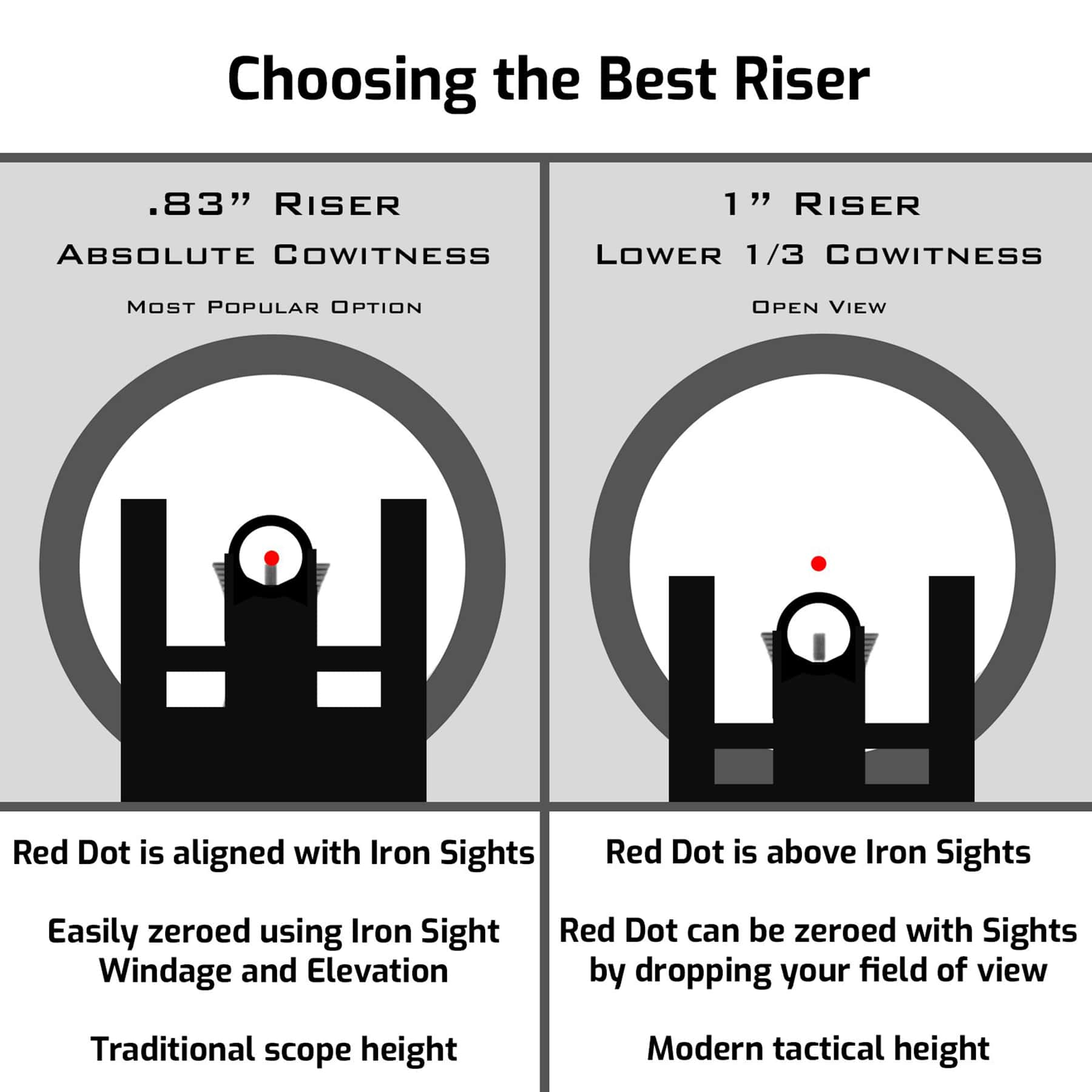
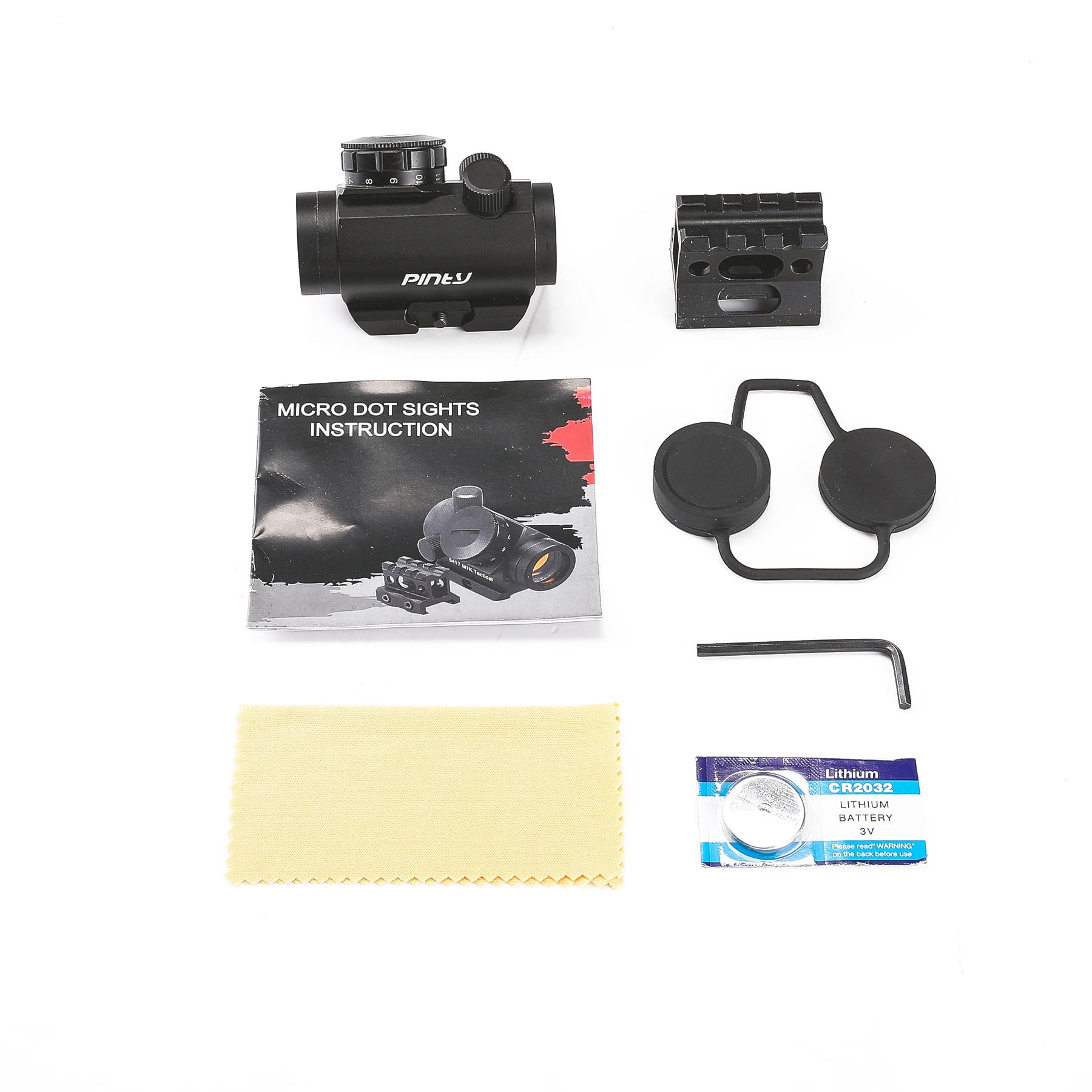
The popularity of reflex sights on handguns has transformed modern shooting. When transitioning from traditional iron sights to a rifle optic, one of the most critical decisions you will face is selecting the right reticle size. Measured in Minutes of Angle (MOA), dot sizes typically range from a precise 2 MOA to a highly visible 6 MOA.
Choosing between a 2 MOA and a 6 MOA red dot is not merely a matter of personal preference—it directly impacts your target acquisition speed, precision at distance, and performance under stress. This comprehensive guide breaks down everything you need to know to make the right choice for your pistol, everyday carry (EDC) setup, and eye health.
What Does MOA Mean in Red Dot Sights?
MOA stands for Minute of Angle, which is an angular measurement used in firearms optics to determine variance or size at distance. One Minute of Angle is equal to 1/60th of a single degree of a circle.
In practical terms, 1 MOA subtends roughly 1 inch at 100 yards (more precisely, 1.047 inches). As the distance changes, the physical area covered by the dot scales proportionally:
-
2 MOA Dot: Covers ~2 inches at 100 yards, ~1 inch at 50 yards, and ~0.5 inches at 25 yards.
-
6 MOA Dot: Covers ~6 inches at 100 yards, ~3 inches at 50 yards, and ~1.5 inches at 25 yards.
Why MOA Matters in Pistol Optics and Red Dots
On a rifle, which is frequently used at 100 yards and beyond, a smaller MOA is crucial for fine precision. On a handgun, however, engagement distances are significantly closer—typically between 3 and 25 yards. At 7 yards, a 6 MOA dot covers less than half an inch of your target. Understanding this scaling effect helps shooters balance the visual feedback they need with the accuracy required for their specific platform.
Common Sizes: 2 MOA, 3 MOA, 6 MOA, 32 MOA Circle
While 2 MOA and 6 MOA represent the two primary philosophies in dot design, other options exist. A 3 MOA dot offers a middle-ground compromise. Brands like Holosun also offer a multi-reticle system (MRS) featuring a 2 MOA center dot surrounded by a large 32 MOA circle, designed to catch the eye quickly during a chaotic draw cycle.
5 Most Common Red Dot Reticle Types
2 MOA vs 6 MOA Basics Explained

What is a 2 MOA dot?
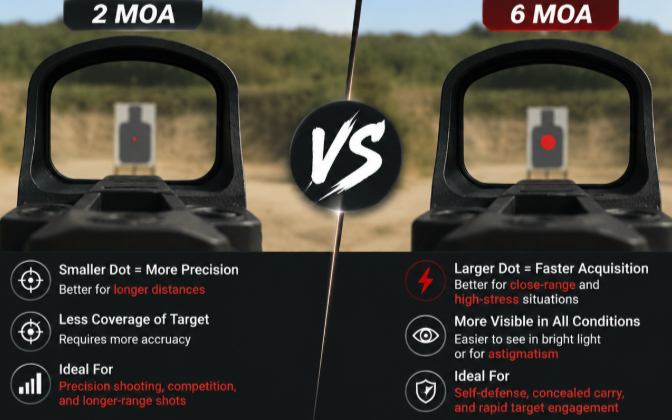
A 2 MOA dot is a crisp, pinpoint dot of light. Because it covers a very small surface area on the target, it provides an unobstructed view of small bullseyes or distant targets. It minimizes target coverage, making it the choice for shooters who prioritize technical precision and tight shot groups.
What is a 6 MOA dot?
A 6 MOA dot is a noticeably larger, bolder bead of light. It is designed primarily to be high-visibility. Because the human eye can register a larger object faster, the 6 MOA dot allows the shooter to immediately locate the reticle upon presenting the firearm, prioritizing immediate alignment over pinpoint accuracy.
Key Difference
-
Precision vs. Speed Tradeoff: The 2 MOA dot leans heavily toward accuracy and surgical shot placement. The 6 MOA dot sacrifices a marginal amount of extreme-distance precision in exchange for raw, reactive speed.
-
Visibility: In harsh, bright daylight or highly dynamic low-light environments, a 6 MOA dot stands out naturally without needing to turn the brightness up to its maximum, bleeding-edge setting.
2 MOA vs 6 MOA for Pistol Shooting
Unlike rifles, pistols lack a third point of contact (the stock resting against your shoulder), making handguns inherently less stable. When you present a pistol, the optic moves dynamically as your wrists align. A larger dot appears in your window sooner during this presentation, allowing you to break the shot faster.
Choosing the Best MOA for Pistol Red Dot Sights
Close-Range Defensive Shooting Needs
Statistics show that the vast majority of defensive handgun engagements occur within 7 yards. At this distance, a criminal threat is large, and your fine motor skills will degrade due to adrenaline. A 6 MOA dot ensures that you have an unmistakable, easy-to-track aiming point when seconds matter.
Competition Shooting vs. Defensive Carry
In action shooting sports like USPSA or IDPA, competitors often prefer a larger dot (5 MOA to 8 MOA) because it tracks smoothly through recoil, allowing for blazing-fast transitions between close targets. For defensive carry, the logic remains identical: speed and acceptable combat accuracy outweigh the need to shoot a one-inch group at 50 yards.
2 MOA vs 6 MOA Pistol Performance Comparison
With a 2 MOA dot on a handgun, shooters often experience "dot hunt"—slight alignment errors upon drawing cause the tiny dot to hide in the corners of the glass window. Conversely, the 6 MOA dot fills a larger portion of the window, providing immediate feedback on how your alignment needs to be corrected.
2 MOA vs 6 MOA for Concealed Carry (EDC)
-
Fast Target Acquisition in Self-Defense
In an Everyday Carry (EDC) scenario, threats are sudden and unpredictable. You may be moving, drawing from concealment, or shooting from unconventional positions. A 6 MOA dot reduces the cognitive load required to find your sight alignment under extreme stress.
-
Draw Speed and Sight Tracking
When tracking your sights during rapid fire, a handgun's slide reciprocates violently. A 2 MOA dot can easily vanish from the window during recoil, forcing you to re-acquire it for follow-up shots. A 6 MOA dot stays highly visible in your peripheral vision, allowing you to track its predictable arc up and down throughout rapid strings of fire.
-
Why Many Shooters Prefer 6 MOA for Carry
Experienced defensive instructors increasingly advocate for the 6 MOA configuration for EDC. The large reticle acts as a high-speed reference point. You can superimpose the big dot over the center mass of a target instantly, achieving a reliable hit without waiting for a tiny dot to settle perfectly.
-
When 2 MOA Still Makes Sense
A 2 MOA dot remains highly viable for EDC if you carry a full-sized pistol, regularly train at longer distances (25+ yards), or if you choose an optic that features an outer ring (such as a 32 MOA circle) to assist with the initial draw speed.
2 MOA vs 6 MOA and Astigmatism
Astigmatism is an imperfection in the curvature of your eye’s cornea or lens. When viewing an illuminated, point-source light like a red dot, an astigmatism distorts the light. Instead of a perfect sphere, the shooter sees a blurry smear, a comet tail, or a "starburst" effect.
2 MOA vs 6 MOA Visibility
Counter-intuitively, turning up the brightness on a small 2 MOA dot to make it more visible often exacerbates astigmatism. The intense light floods the distorted lens, blowing up the starburst effect until the 2 MOA dot looks like an irregular, jagged 10 MOA blob.
Because a 6 MOA dot has a physically larger emitter surface area, you can run the optic at a lower, more comfortable brightness setting while maintaining excellent visibility. For many shooters with astigmatism, a large dot at a lower brightness setting yields a rounder, more consistent, and less distorted aiming point than a small dot cranked to maximum brightness.
Practical Recommendation for Astigmatism Shooters
If you suffer from severe astigmatism:
-
Choose a 6 MOA dot and keep the brightness at a moderate level.
-
Consider a Green Dot, as the human eye processes the green wavelength more naturally.
-
Look past the dot at the target; focusing intensely on the glass window will always make the starburst effect appear worse.
2 MOA vs 6 MOA Red Dot: Visibility vs Precision
Under intense, direct noon sunlight, small dots can wash out against light-colored targets like concrete or tan dirt berms. A 6 MOA dot provides a substantial block of color that resists washout, ensuring you don't lose your point of aim.
Indoor ranges and low-light defensive situations require low or medium brightness settings to prevent the reticle from overwhelming your night vision. At these lower settings, a 2 MOA dot can feel incredibly faint, while a 6 MOA dot remains easily distinguishable.
-
0–15 Yards: 6 MOA dominates. Target tracking is smooth, and speed is unmatched.
-
25+ Yards: 2 MOA takes the lead. At extended handgun ranges, a 6 MOA dot will completely cover a small 6-inch steel plate, making precise holdovers difficult. The 2 MOA dot allows you to see the edges of your target clearly.
Green Dot vs Red Dot: 2 MOA vs 6 MOA
6 MOA Green Dot vs 2 MOA Green Dot Visibility
The debate expands when introducing color. A 6 MOA green dot is arguably the most visible handgun reticle on the market. It offers immense surface area combined with an incredibly bright, eye-catching color palette.
Eye Sensitivity to Green vs. Red
The human eye is biologically calibrated to see the green spectrum better than any other color during daytime hours. Because green appears brighter to our eyes than red at identical power outputs, a 2 MOA green dot can feel just as fast to acquire as a slightly larger red dot, while maintaining a precise footprint.
Battery Consumption Considerations
Green emitters inherently require slightly more power than traditional red emitters. If you select a 6 MOA green dot and run it constantly at ultra-bright settings, your battery life will deplete faster than a 2 MOA red dot counterpart, though modern features like auto-shutdown mitigate this issue significantly.
2 MOA vs 6 MOA: Training vs. Real Defense Preferences
While a 2 MOA dot looks beautiful on a static indoor range bench, it becomes remarkably difficult to track when running dynamic shooting drills, clearing malfunctions, or practicing one-handed weapon manipulations. For dynamic environments, the 6 MOA dot is widely considered the superior practical tool.
2 MOA vs 6 MOA: Side-by-side Comparison Table
|
Use Case |
2 MOA Red Dot |
6 MOA Red Dot |
Winner |
|
Concealed Carry (EDC) |
Slower to find under high stress; requires perfect form. |
Highly visible; immediate target acquisition upon draw. |
6 MOA |
|
Home Defense |
Small aiming point can get lost in dark corridors. |
Large, bright bead easy to locate against low-light threats. |
6 MOA |
|
Competition Shooting |
Excellent for long-range, small steel arrays. |
Faster target transitions and easy tracking during heavy recoil. |
Tie (Preference-Based) |
|
Range Training / Bullseye |
Unbeatable precision; clean tracking of tight shot groups. |
Tends to cover the bullseye at extended distances. |
2 MOA |
|
Beginners |
Can cause frustration due to "searching" for the dot. |
Highly forgiving; helps build intuitive alignment habits. |
6 MOA |
|
Astigmatism Shooters |
Tends to blur or starburst heavily when brightness is high. |
Clearer footprint when run at lower brightness settings. |
6 MOA |
Which One Should You Choose?
Choose 2 MOA if:
-
You prioritize precision, tiny shot groups, and shooting at targets beyond 25 yards.
-
You plan to mount the optic on a rifle, personal defense weapon (PDW), or a full-sized target pistol.
-
You have excellent eyesight and a highly trained, consistent presentation draw stroke.
Choose 6 MOA if:
-
Your primary goal is personal protection, home defense, and everyday concealed carry.
-
You want the fastest possible target acquisition speed under life-threatening stress.
-
You suffer from astigmatism or older eyes that require a prominent, high-contrast aiming point.
-
You are a beginner looking for a forgiving optic that simplifies the red dot learning curve.
FAQ
What is better, 2 MOA or 6 MOA red dot?
Neither is objectively better; they serve different purposes. A 2 MOA dot is superior for distance accuracy and precision work. A 6 MOA dot is superior for close-range speed, self-defense, and fast target tracking.
What distance is 6 MOA good for?
A 6 MOA dot shines brightest at 0 to 25 yards.
This makes it the absolute sweet spot for handguns, home defense, and concealed carry (EDC). Within this range, you can superimpose that big, bright dot over the center-mass of a target instantly and break your shot without waiting for a tiny dot to settle.
Once you push past 50 yards, the dot will cover about 3 inches of the target, and at 100 yards, it covers 6 inches. At those extended ranges, it starts to become "too big" because it hides smaller targets.
Is 6 MOA better for pistols?
For defensive pistols and everyday carry, yes. Most tactical instructors recommend a larger dot (6 MOA) for handguns because defensive encounters happen quickly and at close range, where speed is paramount.
Does astigmatism affect 2 MOA vs. 6 MOA differently?
Yes. A 2 MOA dot often requires higher brightness settings to be seen quickly, which worsens the starburst effect of an astigmatism. A 6 MOA dot can be run at lower brightness while remaining visible, often rendering a cleaner shape for distorted eyes.
Is 2 MOA too small for a handgun?
No, it is not too small, but it requires a consistent draw stroke. If your presentation is unrefined, you may spend valuable time "hunting" for a 2 MOA dot in the window.
What is the difference between EPS Carry 2 MOA vs. 6 MOA?
The internal features, battery life, and durability are identical. The only difference is the physical size of the aiming reticle inside the glass window—2 MOA offers a tiny precision point, while 6 MOA offers a larger, high-speed defensive dot.
Is a 6 MOA dot too big for accuracy?
At self-defense ranges (3 to 15 yards), it is exceptionally accurate, covering only a fraction of an inch. It only becomes too large at distances beyond 25–50 yards, where it begins to obscure small targets.
Should beginners choose 2 MOA or 6 MOA?
Beginners should lean toward a 6 MOA dot. It is far more forgiving to look at, easier to find during the presentation, and helps prevent the bad habit of looking at the dot instead of focusing on the target.
5 MOA vs. 6 MOA: which is better?
They are functionally identical in the field. The 1 MOA variance between them is barely noticeable to the human eye during rapid strings of fire.
2 MOA dot vs. 6 MOA dot for EDC?
The 6 MOA dot is widely considered better for EDC because it maximizes target acquisition speed and ensures reliable visibility under high stress.
6 MOA vs. 2 MOA green dot differences?
A 6 MOA green dot offers maximum immediate visibility to the human eye but uses slightly more battery power. A 2 MOA green dot balances precision with a naturally eye-catching color footprint.
Final Verdict
The battle between the 2 MOA and 6 MOA red dot ultimately rests on a classic trade-off: Precision vs. Speed.
If your shooting goals involve ringing small steel targets at extended distances, slow-fire precision bullseye shooting, or rifle applications, the 2 MOA dot provides the clean sight picture you need.
However, if you are setting up a handgun for personal protection, duty wear, or everyday concealed carry, the 6 MOA dot is the modern tactical choice. Its ability to catch your eye instantly during an emergency draw, track seamlessly through heavy recoil, and mitigate the visual distortions of astigmatism makes it an invaluable defensive asset when every millisecond counts.

Share:
2 MOA vs. 3 MOA Red Dot: Which Reticle Size Is Best?
Best Red Dot Sights for Pistols: Complete Guide