

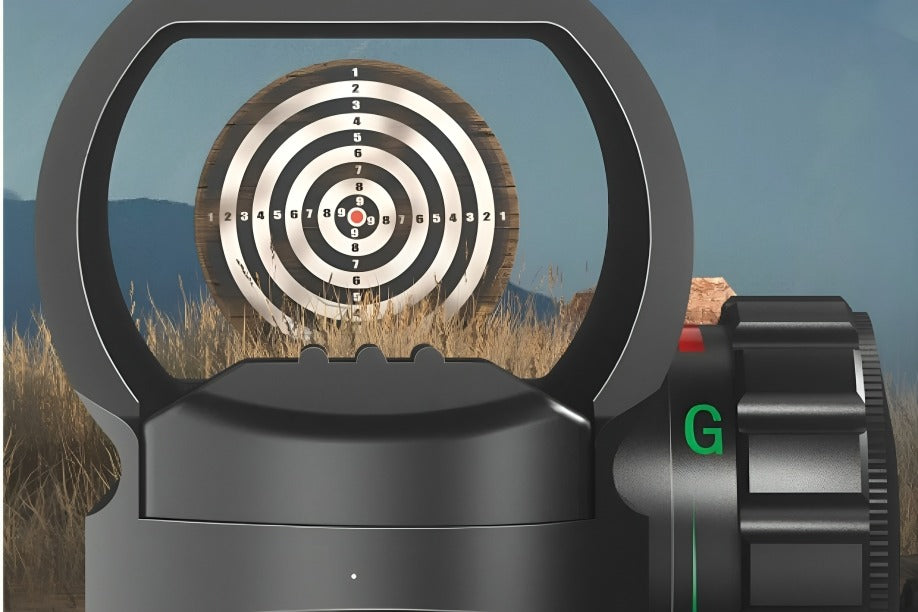
One of the first things that might confuse a new shooter when out shopping for a red dot sight is just how many different types of red dot reticles there are. Some are the classic simple dots. Some are circles. Some look like tiny crosshairs. And some sights let you switch between multiple reticles altogether.
The key to choosing the right red dot reticle pattern is simple: choose the one that is most suitable for the kind of shooting you do, and feels more natural to your personal shooting style and preferences.
However, sometimes, the smart thing to do is to try out as many of them as you can to get the right fit, and an understanding of what each red dot reticle is designed to do and how it works will certainly help you make that decision.
5 Most Common Red Dot Reticle Types
There are 5 main types of red dot reticles, and these are the ones you will see most often: the simple red dot reticle, the circle red dot reticle, red dot with holdovers, corsair or cross-dot reticles, and the chevron reticle.
Understanding how each one caters to different shooting styles, distances, and levels of experience is the foundation for choosing the right red dot reticle.

1. The Simple Dot (2 MOA or 3 MOA)
The simple red dot is the classic, most recognizable red dot reticle. It is “simple” because it comprises a single red dot, often 2–3 MOA in size.
The main advantage of the single red dot is that the small MOA dot gives you a clean, uncluttered sight picture. It is fast to pick up, and yet precise enough for hits at 100+ yards without obscuring your target.
Best Uses for a simple red dot reticle.
- Speed at close to mid-range distances
- General-purpose shooting
- Rifles, shotguns, PCCs, and pistols
- Shooters who prefer simplicity
If you want a no-fuss, do-everything optic that allows you to shoot at a variety of distances, with a crisp, clean sight picture, then the simple red dot is the perfect red dot reticle for you.
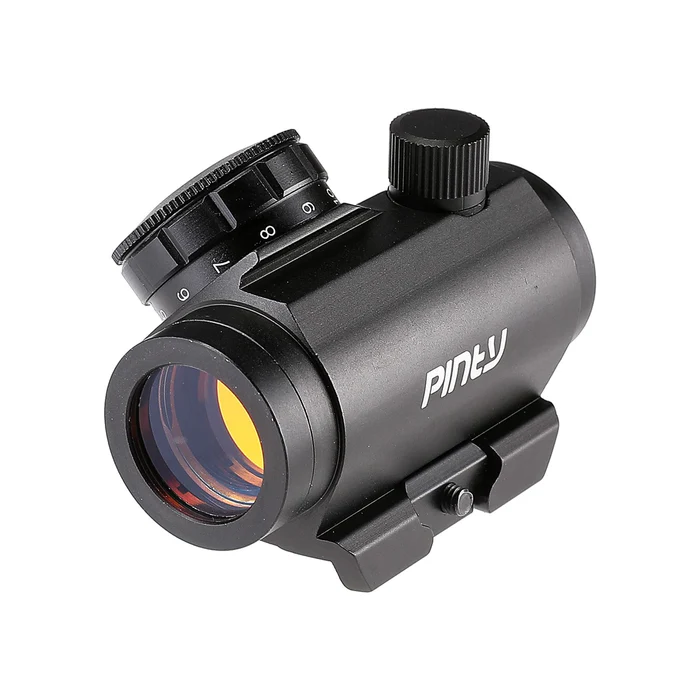
A simple red dot sight like Pinty’s 2MOA Smiley Red Dot Reticle is also incredibly beginner-friendly, and the fact that many veterans still choose the simple red dot design attests to its appeal and versatility.
2. The Circle Dot (e.g., 2 MOA Dot + 65 MOA Circle)
The circle red dot design is called “circle” because it comprises a central dot surrounded by a larger outer circle. It is also called an “EOTech-style” reticle, and it excels because the large ring naturally draws your eye to the center. It also helps you “drive” the reticle during rapid movement or transitions, making it ideal for high-speed environments.
Best Uses of Circle Red Dot
- Close-quarters shooting
- Fast target acquisition
- Defensive use, duty use, and 3-gun competitions
Consider the circle red dot if you engage mostly at 0-50 yards, and you want the fastest possible sight picture. It is also perfect if you habitually shoot on the move or under time pressure

3. Dot with Holdovers/Bullet Drop Compensation (BDC) Marks
The dot with holdovers/BDC marks red dot design is simply a central dot with additional marks or hashes underneath to estimate bullet drop at multiple distances.
The added hashes let you hold over without dialing elevation adjustments, and the reticle gives precision shooters extra reference points without switching to a magnified optic.
BDC Red Dots: Best Uses
- Longer-range shooting (200–400 yards)
- Caliber-specific or precision-oriented setups
- Shooters familiar with ballistic performance
A BDC red dot is best if you shoot 5.56, 7.62, or similar calibers at a longer distance, where you want to push a red dot farther than usual. Also, if you simply prefer structure and visual references in their reticle, then a BDC red dot is an ideal option.
4. Crosshair or Cross-Dot Reticles
Crosshair or cross-dot reticles are simply a small crosshair, sometimes with a dot in the middle. Now, these are less common in red dots, but some people favor them because the intersecting lines give more structure for alignment, which some shooters find stabilizing for slow, aimed fire.
Crosshair or Cross Dot Reticles: Best Uses
- Precision pistol shooting
- Steadier mid-range shots
- Users who want a hybrid red dot/reflex sight feel
Consider a crosshair or cross-dot reticle if you would like to embody the feel of a more “traditional" optic, or if you like having the lines to help guide your precision, but you don't want a full scope. Take note, however, that you are going to have to slow down (considering you are using a red dot), and shoot slower, more deliberate shots
5. Chevron Reticle
The Chevron reticle for red dots looks like an inverted V (chevron) instead of a dot. The good thing about this reticle design is that the tip of the chevron allows pinpoint precision. Also, the shape is quite easy to pick up quickly with both eyes open.
Chevron Reticle Design: Best Uses
- Fast acquisition
- More precise aiming at the tip
- Shooters who dislike dots covering small targets
If you shoot at both close and moderate distances, or if you want some speed and precision without switching reticles, a Chevron reticle would be great for your red dot. Also consider it if you think you would do better with a non-circular aiming point.
 How to Choose the Right Red Dot Reticle for Your Needs
Choosing a reticle comes down to two things: (1) What you’re shooting, and (2) How you shoot. Here’s how to pick based on your real-world application:
| Your Need | Recommended Reticle Type | Why It’s a Good Fit |
| Most versatile option | Simple Dot (2-3 MOA) | Works on rifles, pistols, and shotguns; fast up close and accurate at distance. |
| Mostly shoot indoors or at close range | Circle Dot | Ideal for home defense and dynamic shooting, fast target acquisition. |
| Shoot long distances (200+ yards) | Dot + BDC Holdovers | Provides holdover marks for bullet drop; great for AR-15/AR-10 and extending range. |
| Prefer precision over speed | Crosshair or Chevron | Offers a more defined aiming point for deliberate, accurate shots. |
| New to shooting | Simple Dot or Circle Dot | Easiest to learn on; simple, intuitive, and very forgiving for beginners. |
What Are Multi-Reticle Red Dot Sights
Multi-reticle sights let you switch between different reticles using a button or dial. The most common multi-reticle red dots offer 2 to 4 reticle options, such as dot only, circle dot, circle only, Dot + crosshair, Chevron + dot, etc.
The biggest advantage of multi-reticle red dots is that they are customizable. You find the combination that works best for your shooting style, and even have the option to explore more combinations at any moment. For example, you might use a circle dot for home defense but switch to a single 2 MOA dot for precise 100-yard shots during training.
Advantages of Multi-Reticle Red Dot Sights
With a multi-reticle red dot, you also get more advantages, like:
- They are great for beginners who aren’t sure what they like yet
- Many red dot sights with multiple reticles are also adaptable to multiple firearms. So you get one sight that goes on everything.
- Having multiple reticles can also be pretty useful when you are confronted with mixed-distance shooting environments.
If you are a new shooter, a multi-weapon owner, or a competition shooter, you would most definitely find a lot of value and uses for a multiple reticle red dot sight.
They are also worth exploring, even if you are not any of the above, but you want a single optic that gives you that flexibility.
Single vs Dual vs Multi-Reticle Red Dots (Comparison Table + How to Choose)
| Feature | Single Reticle | Dual Reticle | Multi-Reticle (3+) |
| Complexity | Very simple | Moderate | Most complex |
| Flexibility | Low | Medium | High |
| Typical Options | Dot | Dot + Circle | Dot + Circle + BDC + others |
| Best For | Beginners, pure simplicity | Versatile shooters | Competition, training, multi-gun |
| Price | Lowest | Mid | Highest |
| Learning Curve | Easiest | Easy | Moderate |
| Ideal Distance | General use | Close + mid-range | All distances |
Choose a Single-Reticle Red Dot If You Want:
- The simplest sight picture
- A rugged, reliable optic with fewer electronics
- A sight for one dedicated purpose (e.g., PCC, pistol, or home defense)
Choose a Dual-Reticle Red Dot If You Want:
- Flexibility without too many options
- Ability to switch between dot-only and circle-dot setups
- A sight that works well both indoors and outdoors
Choose a Multi-Reticle Red Dot If You Want:
- Maximum adaptability
- One optic that works for multiple firearms
- Access to BDC, chevron, circle, and dot combinations
- A tool that grows with your skill level
 Final Thoughts on Red Dot Reticle Types
Red dot reticles may seem confusing at first, but once you understand what each type is designed for, choosing one becomes much easier. Whether you want fast target acquisition, long-range precision, or all-around versatility, there’s a reticle type that fits your style.
And if you’re still unsure?
Remember that a multi-reticle red dot lets you test and switch between options until you find the one that feels just right in your hands.





Share:
Texas 2025–2026 Game and Furbearer Hunting Seasons
Montana 2025–2026 Game and Furbearer Hunting Seasons