

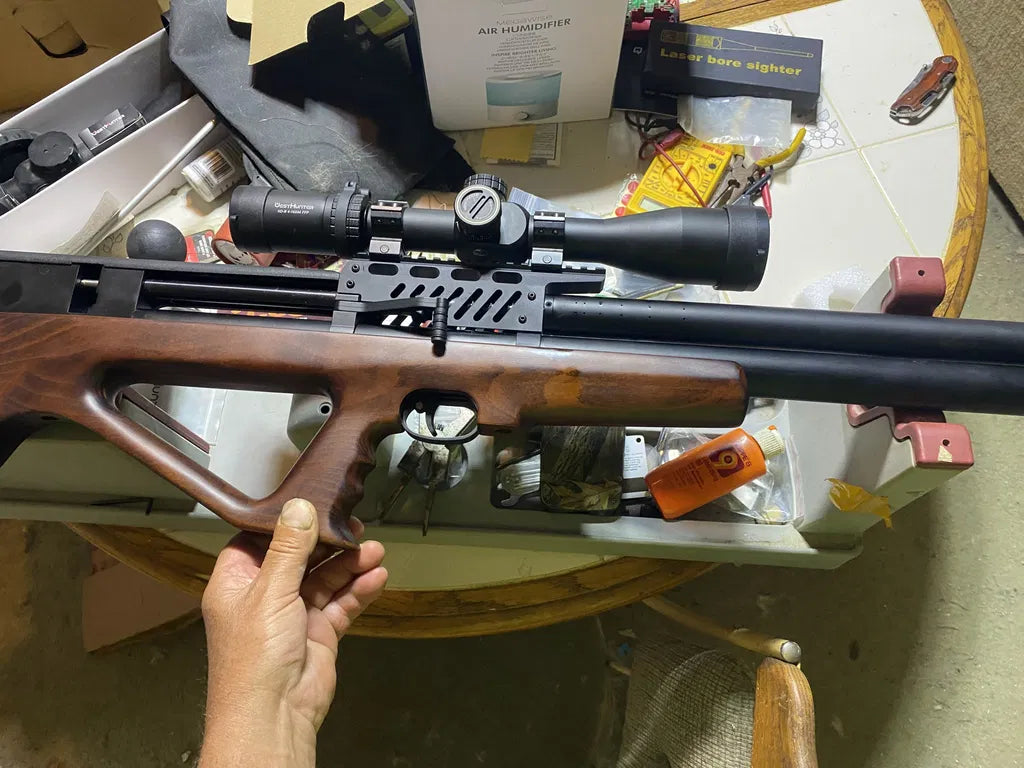
Can a budget PCP air rifle actually compete in N50 benchrest, HFT, or a PRS-style precision match? The answer has less to do with the rifle's price tag than with caliber rules, energy ceilings, and match format. The same Pinty Striker .25 that is legal in an N50 Pellet Rifle class is outside the rulebook for AAFTA-style HFT, and sits in a different kind of gray zone at an IPAC-style precision event—legal to enter, but not built for every stage on the course.
This article is not about whether Pinty has won a match. It is about what a budget regulated PCP can realistically do in competition, where the rule boundaries actually sit, and what is changing in those rules right now.

The Short Answer: Three Formats, Three Different Verdicts
N50 Benchrest — legal right now, but the window is closing. N50's published Pellet Rifle rules allow .177, .22, .25, and .30 caliber commercial Diabolo pellets, with a 100 ft-lb ceiling, at 50 yards, 20 minutes per target. A Striker .25 shooting 42–44 ft-lbs is comfortably inside that ceiling. But N50 has announced that after the 2026 summer season ends on October 31, the league is sunsetting all calibers except .22. The .25 is legal this season, not long-term.
AAFTA HFT / Field Target — not a .25-friendly format. AAFTA-style hunter field target runs on a 20 ft-lb energy ceiling, with .177, .20, and .22 as the mainstream caliber framework. A Striker .25 at 42–44 ft-lbs is more than double that ceiling, and the caliber itself falls outside the standard HFT envelope. This is not a question of whether the rifle is "good enough." It is a question of match design and caliber fit.
IPAC / PRS-style precision — worth watching as an entry point, but you need to understand the format. IPAC (International Precision Airgun Competition) launched in May 2026 in Leesburg, Florida, with 100-yard benchrest, 150-yard benchrest, and a PRS-style Extreme Long Range course extending past 800 yards. It does not carry N50's hard caliber sunset, but a Striker .25 is not an 800-yard ELR rig. It has a usable precision baseline at 100-yard benchrest and runs into clear platform limits at longer distances and in ELR.
N50 Benchrest: Legal, But Read the Timeline First
N50's Pellet Rifle class is currently the most welcoming organized benchrest entry for a .25 PCP. The published rules are direct: .177, .22, .25, and .30 commercial Diabolo pellets are allowed in the Pellet Rifle class, with a 100 ft-lb maximum, at 50 yards, 20 minutes per target. One-piece rests, two-piece rests, bags, bipods, and single-load trays are permitted.

Where does the Striker .25 actually sit inside that framework? Pinty's in-house chronograph data recorded 889 FPS, 44 ft-lbs, 31 regulated shots, and a 4.9 FPS standard deviation with JSB 25-grain-class pellets. A separate Pinty test using JTS Dead Center 25.39-grain pellets averaged around 865 FPS and 42 ft-lbs, also with a tight spread. At 44 ft-lbs, the rifle is using less than half of the 100 ft-lb ceiling. A 50-yard single-shot cadence does not reward maximum velocity. What gets rewarded over 20 minutes per target is regulated consistency, and a 4.9 FPS standard deviation is solid for a PCP in this price range. At 50 yards, vertical dispersion is more likely to come from wind and aim than from the rifle's energy swing.
But the rule change has to be stated plainly. N50 has announced that after the 2026 summer season ends on October 31, it is sunsetting all calibers except .22, making N50 a .22-only discipline going forward. The .25 and .30 remain legal this season, but shooters need to plan around the change. That makes the Striker .25's N50 legality a window, not a permanent status. If the goal is long-term N50 participation, .22 is the caliber that survives the rule change. If you already own a .25, or you want to try benchrest this season, the Striker .25 is fully legal while the window is open.
HFT / Field Target: A Double Boundary on Caliber and Energy
AAFTA-style Hunter Field Target and standard Field Target operate on a 20 ft-lb energy ceiling, with .177, .20, and .22 as the mainstream caliber framework. Some rule discussions note that a .20 or .22 rifle may need to be tuned down to stay under 20 fpe, and that .177 is often treated as the preferred caliber precisely because it fits that energy window more easily.
A Striker .25 at 42–44 ft-lbs is more than twice the 20 ft-lb ceiling, and the caliber itself is outside the standard AAFTA HFT envelope. Pushing a .25 into HFT means either failing the chronograph or tuning the rifle far below its designed operating point—which defeats the purpose of a regulated .25 platform. Writing that boundary honestly is more useful than blurring it: if the goal is AAFTA-style field target, .25 should not be the first caliber on the list; .177 and .22 have the more mature rule space and pellet selection for that format.

IPAC and PRS-Style: A Wider Door, But Read the Format
IPAC launched in May 2026 in Leesburg, Florida, hosted by AEA, BinTac, and 413 Airguns. The inaugural event included traditional 100-yard benchrest, 150-yard benchrest, and a PRS-style ELR course extending beyond 800 yards. It is not a "budget gun fun shoot." It is a precision long-range event built to that standard.
The publicly documented Pinty–IPAC connection is this: the Airgun Geek podcast discussed IPAC Florida and "Bill's new relationship with Pinty Airguns" in the same conversation. That is not the same as Pinty sponsoring IPAC, and it is not the same as Pinty placing at IPAC. This article does not claim either.
So where does the Striker .25 actually fit in an IPAC context? It is a budget platform that can get a shooter onto a precision course, not a rig built for 800-yard ELR. At the 100-yard benchrest stage, the regulated consistency of a 25.39-grain pellet is what it brings. At 150 yards and in ELR, its ballistic coefficient and energy reserve run into clear platform limits. PRS-style barricades, positional shooting, and time pressure test the whole system—rifle, optic, rest, and shooter—not a single spec sheet.
An honest way to put it: if you want to experience a precision airgun match on the lowest possible budget and learn how benchrest and positional stages actually feel, the Striker .25 is a legal and accessible entry point. If the goal is competing for a finish in ELR or open-class benchrest, this rifle is not positioned there. Both statements can be true at once. There is no need to twist them into "Pinty can win IPAC."
If You're Actually Going to Shoot One, Here's What Else Matters
Competition does not end with buying a rifle. For a budget .25 PCP, the supporting setup decides whether you are "going to experience it" or "going to pay an entry fee."

A pellet baseline. A 25.39-grain domed pellet is the low-risk starting point for N50 and 100-yard benchrest. The in-house chronograph data already gives a reference of 889 FPS with a 4.9 FPS standard deviation. Before switching to a heavier pellet, confirm that the platform holds a single-digit standard deviation with 25.39 grains. That is the first gate a regulated PCP has to clear before it belongs in a precision setting.
Chronograph data, not advertised velocity. Competition rewards repeatability, not peak FPS. A 31-shot regulated string with a 4.9 FPS standard deviation using a 25.39-grain pellet is worth more at 50-yard benchrest than a higher advertised number with double the spread.
Optics and rest. N50 permits one-piece rests, two-piece rests, bags, and bipods. PRS-style stages have completely different rules for support and shooting position. The same rifle does not use the same surrounding kit in both formats.
Knowing where the boundaries are. If you take a .25 Striker to N50, know that N50 becomes .22-only after the 2026 season. If you take it to IPAC, know that 800-yard ELR is not what the rifle was designed for. If you take it to HFT, know that the 20 ft-lb ceiling and the .177/.20/.22 caliber framework mean the .25 does not belong on that starting line. Knowing the boundaries is part of being prepared to compete.
The Bottom Line: What This Rifle Can and Cannot Do
N50 Benchrest: legal now, but the .25 window closes after the 2026 season, when N50 becomes a .22-only discipline. At 42–44 ft-lbs it sits well inside the 100 ft-lb ceiling, and its regulated consistency is a real advantage—but the rule change needs to be on your radar before you plan a season around it.
AAFTA HFT / Field Target: not a fit, and not worth forcing. The 20 ft-lb energy ceiling and the .177/.20/.22 caliber framework put the Striker .25 in a different match category entirely.
IPAC / PRS-style: enterable, but know you're bringing an experience-level precision platform, not an ELR contender. There is a usable baseline at 100-yard benchrest; 150 yards and ELR expose the platform's limits.
The point of shooting a budget PCP in competition is not to prove it can win open class. It is to use it to understand the rules, understand consistency, and understand what you are actually missing on the course. A $250–$330 regulated .25 that gets you onto a benchrest line for the first time—and lets you explain where every shot landed—has already done the job an entry-level competition platform is supposed to do.
If you're preparing a Pinty Striker .25 for precision or benchrest practice, the Striker .25 chronograph and accuracy data gives you the 25.39-grain-class baseline. Full platform specs and regulated shot count are on the Striker .25 product page. If you're still deciding whether .25 fits your goals at all, the .177 vs .22 vs .25 caliber guide breaks down how the three calibers differ in energy, pellet weight, and practical use.



Share:
.25 Caliber PCP Pellet Weight: How to Choose the Right Grain for 50 and 100 Yards