

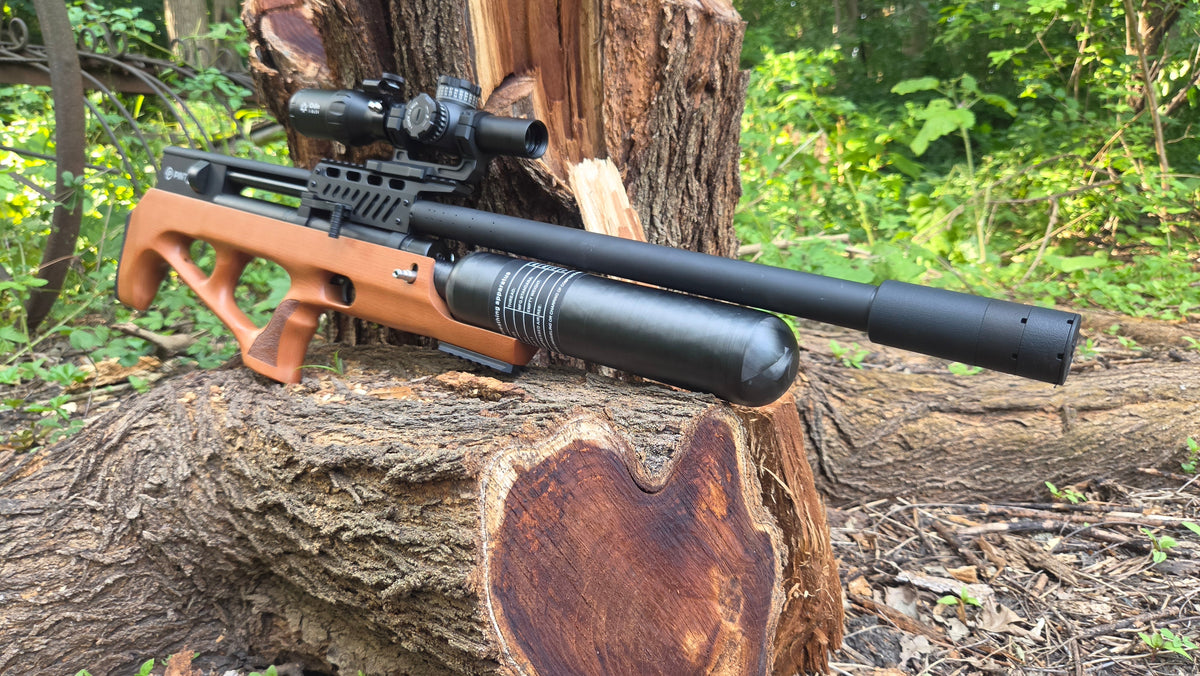
I, like a good number of people who are getting into PCP air rifle shooting for the first time, used to think a pellet gun and a BB gun were basically the same thing. All I knew coming in was: both are air-powered, both punch holes in cans, and BBs are cheaper. So why not just buy the BB gun?
My first moment of realization came when I spent an afternoon trying to hit a small target at 15 yards with a smoothbore BB gun. The wind nudged my shots around, and I was off by inches on most of them. That was the day I stopped treating these two as the same tool.
They're not. One is a toy with a trigger. The other is a precision system. Here's the real difference.

BB vs pellet: the difference in one sentence
A BB is a round steel or alloy ball that travels down a smoothbore barrel with no spin. A pellet (usually a lead pellet) has a nose and a skirt, and the skirt flares under pressure to grip the rifling, which spins the projectile and stabilizes it in flight.
BB Gun
Round steel ball. Travels down a smoothbore barrel. No spin, no stabilization. Cheap, but inaccurate.
Pellet Gun
Skirted lead pellet. Grips the rifling and spins. This aerodynamic stabilization is why it's accurate at distance.
That single design difference is why everything else, from accuracy, range, cost, and even safety, plays out the way it does.
Accuracy: BBs hit, pellets repeat
BB guns are great fun. Plinking cans, racing friends, knocking down reactive targets - BBs are cheap and fast, and there's nothing wrong with that.
But if you want five shots to land in one ragged hole, a BB gun won't get you there. Round steel in a smoothbore doesn't stabilize, so the group opens up fast, especially past 10–15 yards.
A pellet gun with a rifled barrel is a different story. The skirt engages the rifling, the pellet spins, and the group tightens. On a PCP platform, a .22 lead pellet at 25 yards is noticeably more stable than a light .177 pellet, and it handles wind better too.

A Warning I Wish Someone Gave Me
Don't shoot steel BBs through a rifled PCP. Steel doesn't deform; it's hard on the rifling, and the ricochet risk is real. Pinty's PCP air rifles are built around pellets, not BBs.
Range: where BBs start to fall apart
A BB is light and round, so it bleeds speed quickly and drifts in the wind. Inside 15 yards, it's fine. Past 20, drop and spread become obvious.
A pellet carries more weight and has a better aerodynamic shape, and the spin keeps it tracking. .22 and .25 lead pellets on a PCP hold energy and consistency much further out. If you're shooting paper, pests, or anything past 25 yards, pellets are the right call.
Cost: price per shot vs. cost per useful shot
BBs win on sticker price. A big box lasts a long time, and for backyard plinking that's hard to argue with.
Lead pellets cost more per round, but that's the wrong number to look at. What matters is cost per useful shot. Pellets come in different grain weights, nose shapes, and brands, and matching them to your gun cuts fliers and wasted ammo.
Grain weight matters more than most beginners expect. Too heavy in a .177, and velocity drops off a cliff. Too light in a .22, and you lose stability at distance. Get it right, and the gun shoots like a different rifle.
This is exactly why Pinty is adding Pinty lead pellets to the lineup. I don't want new shooters buying a PCP and then guessing at ammo for a month. Match the caliber, the grain, and the job, and that’s basically the whole game.

Safety: lead pellets deserve respect
Lead pellets are soft, which is why they seal and shoot well and also why you should wash your hands after handling them. Don't eat or drink while you're loading, and keep them away from kids. This isn't scare tactics; it's just how lead works.
How I'd choose
If you want backyard plinking with friends and zero fuss, a BB gun is fine. Cheap, simple, fun.
If you want accuracy, repeatable groups, pest control, or you already own a PCP air rifle, skip the BB mindset. Pick lead pellets by caliber and grain.
.177 Caliber
For practice and volume. Cheaper to shoot, great for learning fundamentals.
.22 Caliber
The all-around choice. More forgiving in wind and better for pests.
.25 Caliber
When you want weight and reach. Carries energy further downrange.
I still keep a BB gun around. Cans don't stand a chance. But when accuracy matters, I shoot a pellet gun with properly matched lead pellets every time.
FAQ
Is a pellet gun the same as a BB gun?
No. A BB gun fires round steel or alloy balls through a smoothbore barrel. A pellet gun fires skirted pellets, usually lead pellets, through a rifled barrel. The rifling and the skirt are what make pellets more accurate at distance.
Can you shoot BBs in a pellet gun?
Don't. Steel BBs don't deform to the rifling and can damage the barrel. PCP and rifled air rifles are designed for pellets, not BBs.
What pellets are best for a Pinty PCP?
Match the pellet to the caliber and the job. .177 handles lighter pellets well for practice, .22 is the versatile middle ground, and .25 carries more weight for longer shots. Grain weight matters — test a couple of weights before you commit to a full tin. If you're still deciding on caliber, .177 vs .22 vs .25 lays out where each fits.
Is .22 or .177 better for beginners?
.177 is cheaper to shoot and great for learning fundamentals. .22 is more forgiving in wind and better for pests and longer range. If you can only own one, .22 covers more ground.
Coming Soon
The Pinty Official Pellet Series
We're engineering high-precision pellets designed specifically to match the ballistic characteristics of Pinty barrels. While we finish R&D and testing, explore the rifles they're built for.
Explore Pinty PCP Air Rifles



Share:
Pinty Striker .25: Can a Budget PCP Compete in N50, HFT & PRS?
Best Pellets for the Pinty Buster Tactical: What I've Tested and What I'd Buy