

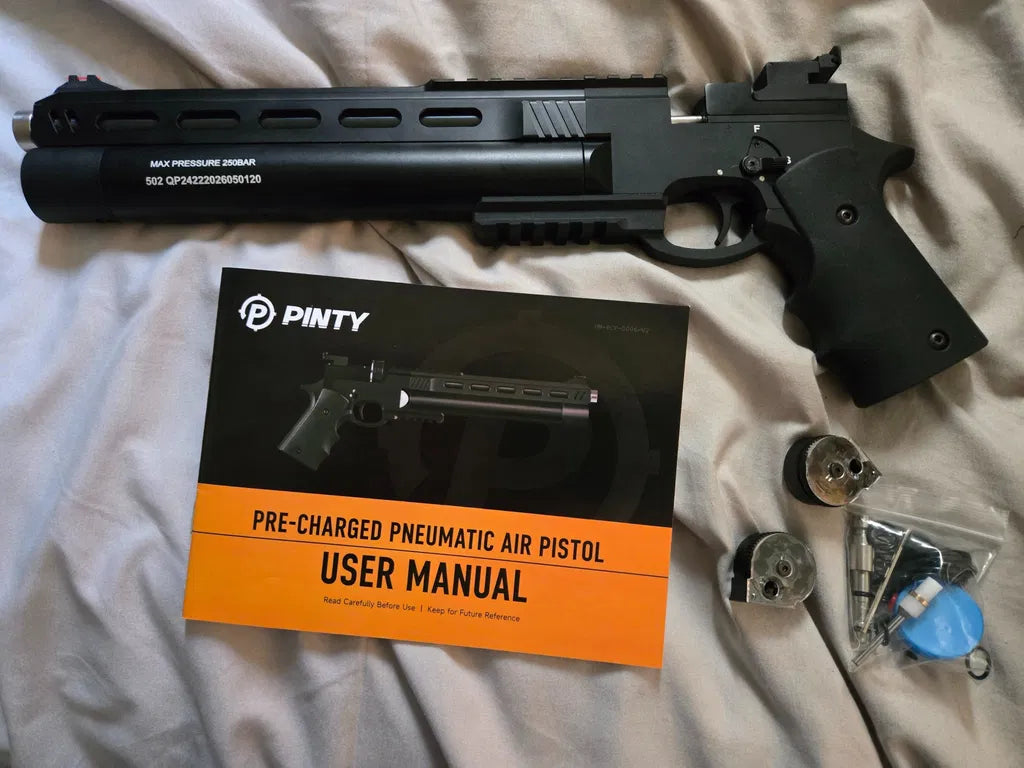
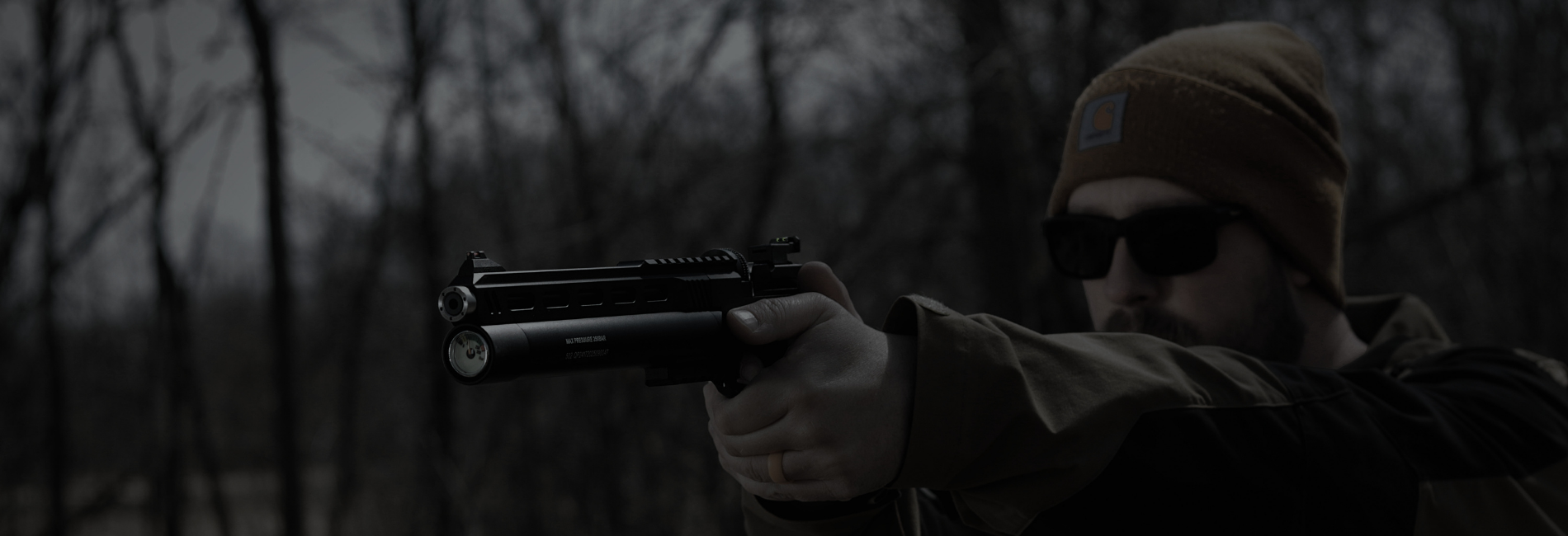
Since the Pinty Buster Tactical landed on my bench, the question I get most isn't "is it accurate?" It's "what pellets should I feed it?"
Fair question. It's a short-barrel PCP air pistol, and it is not the kind of gun that shoots good groups with just any tin of ammo. Short barrel, limited air volume, pick the wrong pellet and velocity drops, groups open up, and you blame the gun. Usually it's the ammo.
This isn't a theory post. It's what I've actually run through the Buster, what worked, and what I'd skip. My testing is backyard-real: 25 yards and in, sandbag rest, light wind or none. Not lab data. I'll flag the numbers I still need to chrono, because I'd rather give you honest field notes than fake precision.

First, understand what the Buster is built for
The Buster comes in .177 and .22, runs a 9-shot magazine, and is built as a compact, repeatable, accurate PCP pistol, not a max-velocity competition gun.
Short barrel means one thing: less time for air to do work. A longer barrel accelerates the pellet more fully. A short barrel sends it out fast but caps the velocity ceiling. On the Buster, that makes pellet weight far more sensitive than on a long-barreled rifle.
That's why I don't recommend dumping heavy rifle pellets into the Buster. A rifle can push them. The Buster may not.
.177: stay in the middle, don't chase heavy
On the .177 Buster, 7 to 10 grains is the stable zone for me. Too light (under 6 grains) gives you speed but the wind pushes it around past 25 yards. Too heavy (over 10.5 grains) drops velocity noticeably and you're recalculating holdover.
My preference is a round-nose pellet around 8 to 9 grains, a good balance of speed and accuracy. Wadcutters cut clean paper holes but fall apart at distance; keep them for 10–15 yards. Pointed pellets didn't show a clear advantage on the Buster for me, and grouped worse than round nose.
Short version: on a .177 Buster, a mid-weight round nose is the safe bet. Don't buy the heaviest tin first.

.22: the Buster's comfort zone, but pick your grain
I like the .22 Buster better. More pellet weight, better wind resistance, and noticeably more stable inside 25 yards than .177.
For me, 14 to 18 grains is the sweet spot. Velocity stays usable and the trajectory holds. Above 18 grains, you can feel the speed drop. Fine for close paper, but you'll be calculating drop further out.
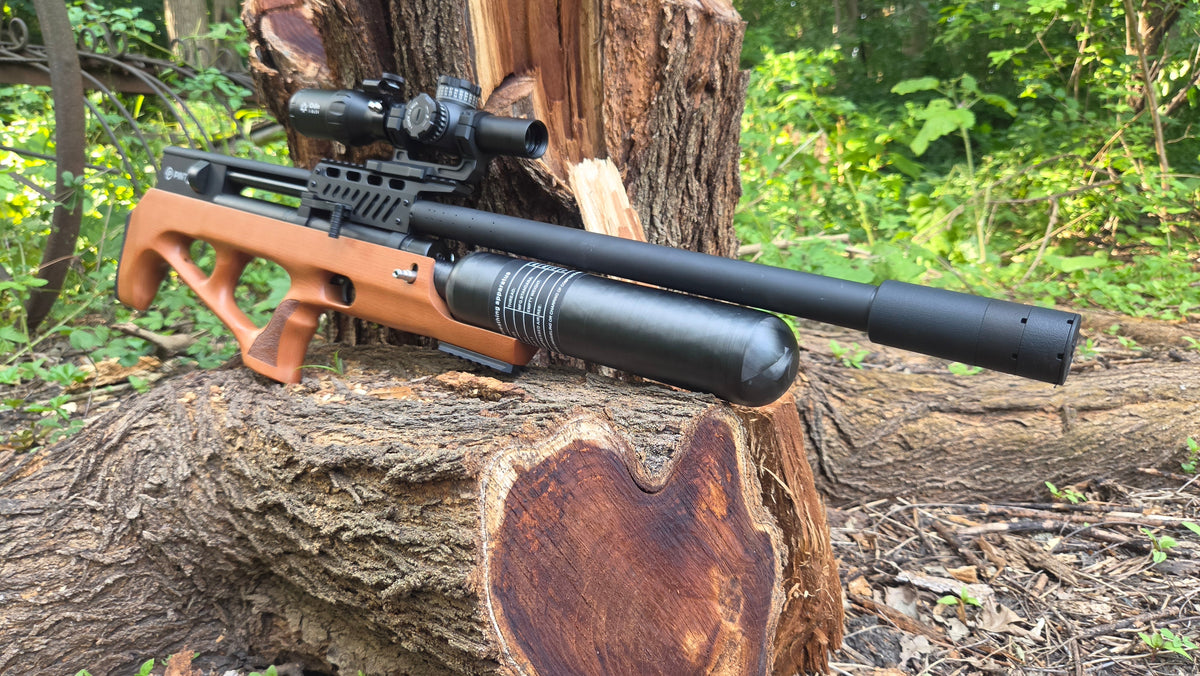
On .22, I lean round nose or round nose hollow point for the mix of accuracy and trajectory. Wadcutters are great on paper, but the Buster isn't a paper-only gun, and you probably won't shoot only paper. If you want a full-sized .22 platform to test those heavier, wind-resistant grains, the Pinty Falcon X .22 PCP airgun offers the barrel length needed to push them efficiently.
Light vs heavy: the real trade-off on a short barrel
A lot of shooters assume heavy equals accurate. On a long rifle, there's some truth to that. On a short-barrel PCP like the Buster, not so much.
Heavy Pellets
Resist wind and hold energy at distance. But a short barrel can't push them hard, so velocity is low, drop is fast, and air consumption goes up (fewer shots per fill).
Light Pellets
Give you speed, a flatter trajectory, and better air efficiency. But they're wind-sensitive and less stable far out.
My advice: learn the gun on a mid-weight pellet first, then adjust for the distance you actually shoot. Don't buy a 500-count tin of the heaviest pellet before you've tested a sampler.

Lead vs alloy
I lean lead pellets. Lead is soft, so the skirt seals the rifling better under pressure, and consistency is tighter. Alloy is harder, deforms less, and on a short-barrel, lower-pressure Buster, it usually isn't as consistent.
Lead Handling Safety
Lead comes with lead responsibilities: wash your hands after handling, don't snack while you're loading, and keep tins away from kids. That's not scare talk. It's basic habit.
Pinty is adding lead pellets to the lineup, and my goal is simple: Buster owners shouldn't have to guess. Match the caliber and the grain, and you're shooting instead of testing.
How I'd start
If you just got a Buster:
Buy small first. For .177, grab a tin of 8–9 grain round nose. For .22, grab 15–16 grain round nose. Shoot 30–50 pellets at 25 yards off a sandbag and look at the group. If it holds, buy bulk. If it doesn't, change grain before you change guns.
The Buster isn't a gun that punishes you for ammo choice forever. But it does reward ten minutes of picking the right pellet. Get that right, and it shoots better than you'd expect from a compact PCP pistol.
FAQ
What pellets work best in the Buster?
For .177, start with 8–9 grain round nose. For .22, start with 15–16 grain round nose. Both calibers prefer mid-weight lead pellets over the heaviest options, because the short barrel can't push heavy pellets efficiently.
Can I use heavy hunting pellets in the Buster?
You can, but expect lower velocity and more drop. Heavy pellets are better suited to longer barrels. In a short-barrel PCP pistol, mid-weight pellets usually group better and use air more efficiently.
Is .177 or .22 better for the Buster?
.177 is cheaper to shoot and fine for close-range practice. .22 is more forgiving in wind and more stable at 25 yards. If you want one do-it-all setup, .22 covers more ground.
Do I need to wash my hands after handling lead pellets?
Yes. Lead pellets are soft and can leave residue on your hands. Wash after loading, avoid eating or drinking while shooting, and store tins out of reach of children.
Coming Soon
The Pinty Official Pellet Series
We're engineering high-precision pellets designed specifically to match the ballistic characteristics of Pinty barrels. While we finish R&D and testing, explore the rifles they're built for.



Share:
Pellet vs BB Gun: What I Wish I Knew Before Buying