

By Bill Ruehl of Target Forge and The Airgun Geeks Podcast
5/6/2026
Why Some Airgun Pellets Fly True (and Others... Well, Let's Just Say They Have Character)
Hey there, fellow airgunner! If you've ever spent a sunny afternoon plinking tin cans or chasing paper targets, you know the quiet thrill when a pellet zips out and lands exactly where you aimed. It's pure magic. But then there are those frustrating days when your groups open up like a bad joke. A lot of that boils down to aerodynamic stability—how well your little lead (or alloy) friend keeps its nose pointed forward and stays on the straight and narrow. Let's chat about why some pellet profiles are rock stars of accuracy while others are more like enthusiastic but wobbly puppies. I'll keep it friendly, promise—no stuffy engineering lectures here.
The Humble Diabolo: Nature's Tiny Shuttlecock

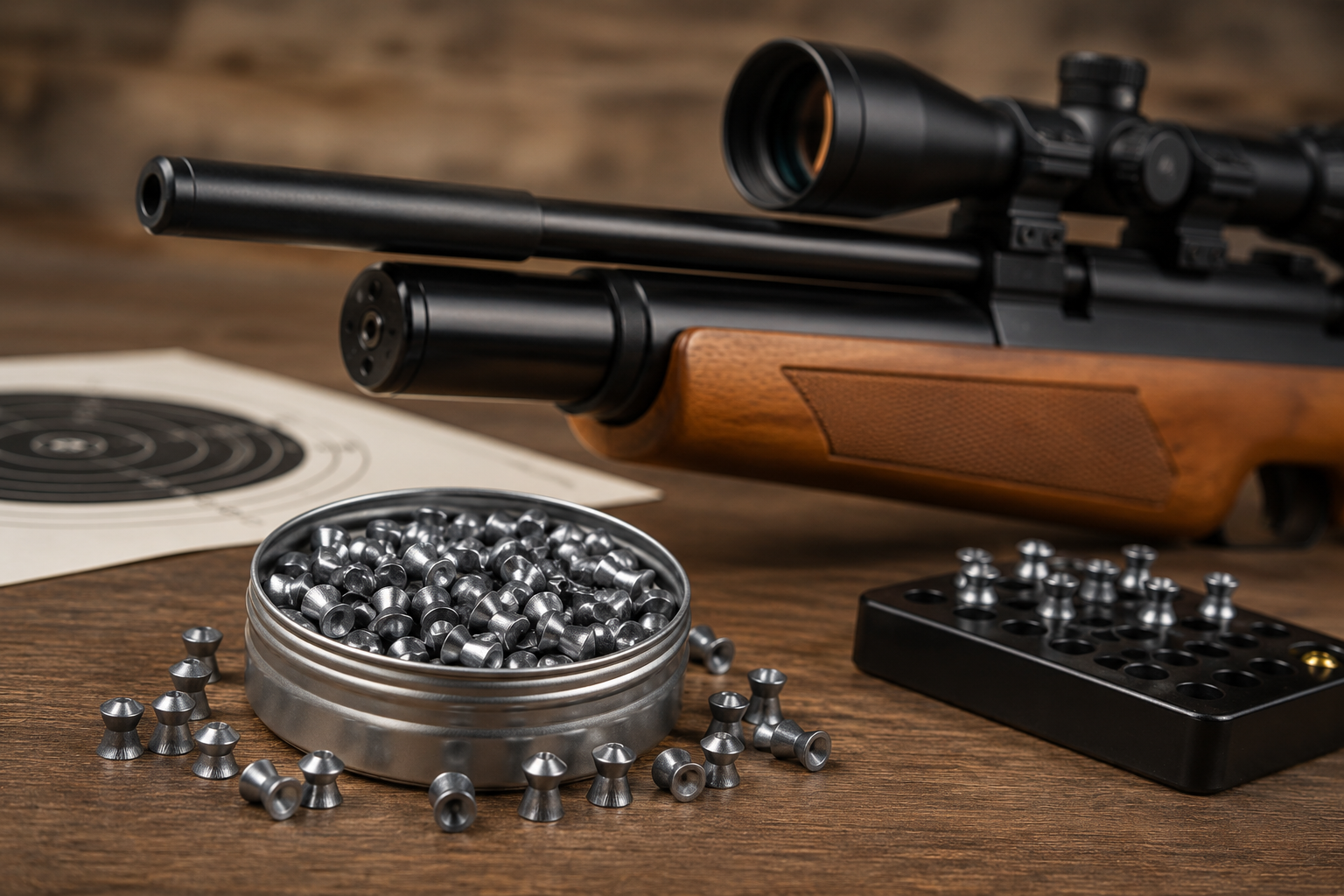
Most airgun pellets follow the classic Diabolo (or waisted) design: a solid, heavier head up front, a narrow waist in the middle, and a thin, flared skirt at the back. This isn't an accident—it's brilliant engineering that mimics how a badminton shuttlecock or dart flies. The heavy head leads the way (thanks to momentum), while the skirt creates drag and lift that keeps everything aligned.
The real hero is the center of pressure (CP) sitting nicely behind the center of gravity (CG). When the pellet starts to yaw (wobble sideways), the airflow pushes more on that flared skirt, creating a restoring moment that gently nudges the nose back into the wind. It's like the pellet is self-correcting: “Whoops, got a bit sideways there—back on track!” This is often called flare stabilization rather than plain old drag stabilization, because it's the lift and suction forces around the skirt doing the heavy lifting, not just blunt resistance.
Subsonic speeds (which is basically all airgun territory) make this even more interesting. High-pressure “impact” forces you might imagine from supersonic bullets don't apply here. Instead, it's all about low-pressure suction and airflow hugging the pellet's curves. Pretty elegant for something you buy by the tin!
Why Domed Pellets Are the Reliable Friends
Round-nosed or domed pellets (think JSB Exact, H&N Field Target Trophy, or RWS Superdomes) are the crowd favorites for good reason. That gentle curve on the head slices through the air with decent efficiency, reducing turbulence while the skirt keeps things stable.
They shine at medium to longer ranges—say 25–100 yards—holding groups tight and resisting wind better than many alternatives.
They're forgiving across different rifles and power levels. The dome doesn't catch the breeze as aggressively as pointier designs, and the overall shape gives a nice balance of ballistic coefficient (how well it slips through air) and stability. Shooters often call them “do-everything” pellets, and with good reason—they're kind, consistent companions on the range.
The Others: Each With Their Own Quirks

● Wadcutter (flat-head)
These are like the friendly neighborhood paper-punchers. The flat front creates a clean hole in targets (great for scoring) and massive drag, which actually helps stability at short ranges by keeping the nose forward. But that drag slows them down fast, so they lose steam and accuracy beyond 25–30 yards. Perfect for backyard fun or low-powered springers, but not marathon runners.
● Pointed pellets
These look speedy and arrow-like, promising to “slice” through the air. Sometimes they do deliver great penetration for hunting. But aerodynamically, the sharp tip can be finicky—tiny manufacturing variations or slight yaw can make the center of pressure shift unpredictably. Many shooters find them less consistent than domes, especially at distance. They're the optimistic athletes who sometimes trip over their own feet.
● Hollow points
Designed for expansion on impact (hello, ethical pest control), these often start as domed pellets with a divot or more dramatic cavity. They can fly surprisingly well if the base design is solid (JSB Hades fans, I'm looking at you). But the hollow can catch wind or shift the CP a bit, making them trickier past 40–50 yards. Great for close-range hunting where terminal performance matters more than pinpoint groups at 80 yards.
Slugs (those more bullet-shaped modern options) are a whole different story—they rely more on spin stabilization from rifling and have higher ballistic coefficients for long-range work, but traditional pellets win on forgiving stability in the subsonic realm. Also, the self-limiting drag of the pellet can be a godsend when pesting and working close to structures, like my farm.

The Spin on Spin (Gyroscopic Help)
Rifling imparts a gentle spin that adds dynamic stability. It doesn't replace the flare effect but helps dampen wobbles over distance. Too little spin and the pellet might tumble; too much (from fast-twist barrels) and it can resist following the curved trajectory, opening groups. Most air rifles are tuned just right for pellets, so you get that sweet spot without overthinking it.
Heavier pellets generally win the stability prize in wind—they carry more momentum and resist being pushed around. Lighter ones zip out faster but can get driftier downrange. It's all about matching pellets to your rifle's personality.

Real-World Wisdom for Happier Shooting

Stability boils down to keeping yaw angles tiny—ideally under a degree or so. Even small wobbles grow over distance, turning tight groups into shotgun patterns. That's why consistent pellets (weight, shape, skirt integrity) from a quality maker make such a difference.
Test a few tins in your gun; what works for your buddy's rifle might not love yours.
Next time you're at the bench, think of your pellet as a tiny, brave traveler through the sky. Give it the best launch (clean barrel, proper seating) and a profile that matches the journey, and it'll reward you with satisfying thwacks on target.
Domed pellets are usually the kindest starting point—reliable, accurate, and forgiving.
Airgunning is supposed to be fun, after all. Whether you're punching paper, hunting ethically, or just enjoying the pop of a well-placed shot, understanding these aerodynamics adds a layer of appreciation.
Your pellets aren't just ammo; they're little feats of physics flying on your behalf.
So load up, breathe steady, and enjoy the flight.
Happy shooting, friend—may your groups stay tight and your misses teach you something new!





Share:
Pinty Striker Bullpup Tested: Budget PCP Rifle That Delivers Power
Pinty Buster PCP Air Pistol Reviews