

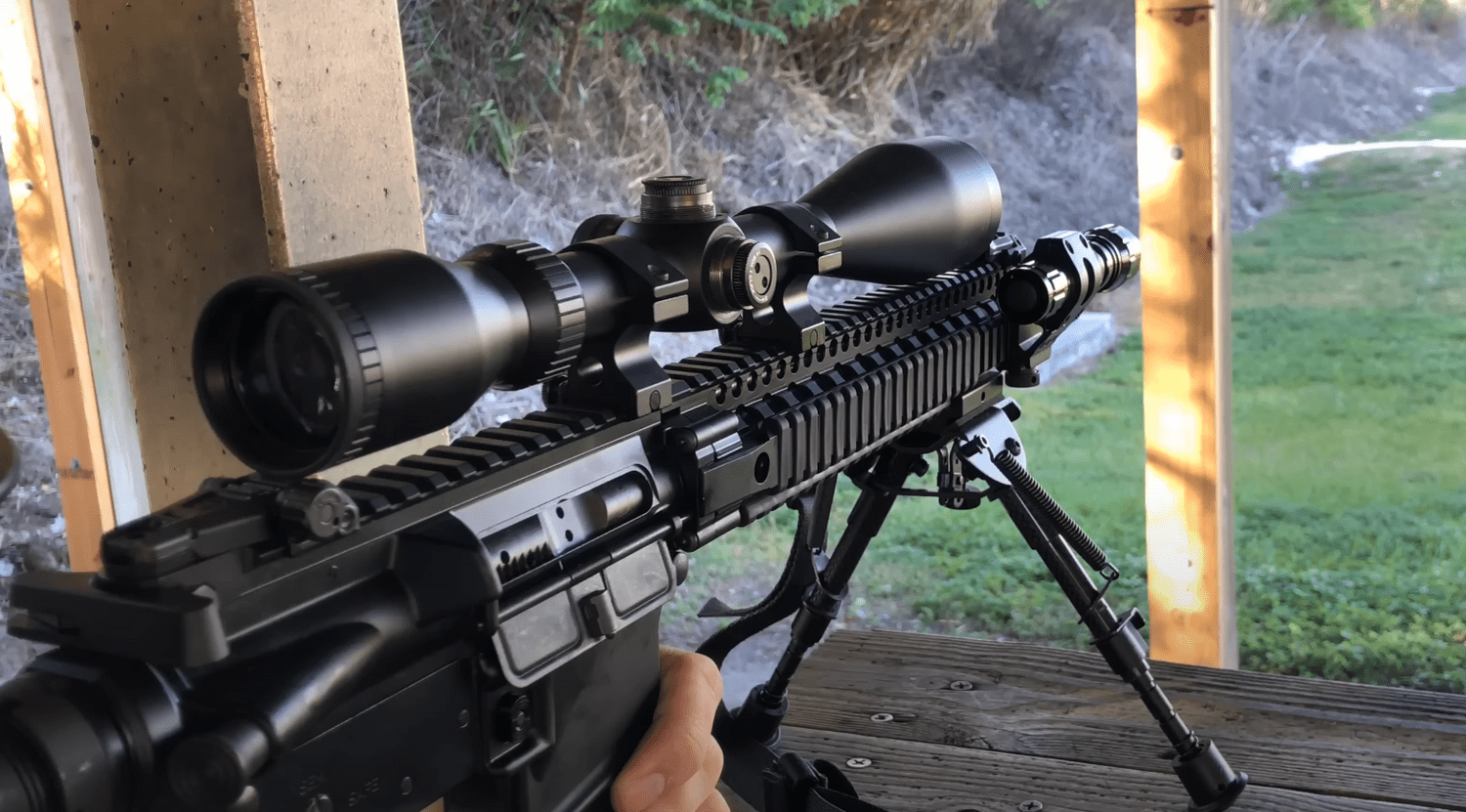
When it comes to zeroing a new firearm, bore sighting your AR-15 is an invaluable first step. A laser bore sighter allows you to align your rifle's optics with the barrel without firing a single round. Not only does this save you time and expensive ammunition, but it also ensures your very first shot gets "on the paper." In this guide, we will break down exactly how to laser bore sight an AR-15, look at the benefits of this method, and explore alternative boresighting techniques to get you range-ready in minutes.
(Reading Time: 2-5 Minutes)
What is a Laser Bore Sight and How Does It Work?
How It Works
The concept is simple: it shows you where the barrel is pointing so you can align your sights to match it.
1. Insert the Bore Sight
You place the device into the firearm’s barrel or chamber. Some models are caliber-specific, while others use adapters.
2. Project the Laser
The bore sight emits a straight laser beam downrange onto a wall, target, or backstop.
3. Align Your Optics
You adjust your scope or sights so the reticle (crosshairs) lines up with the laser dot.
4. Fine-Tuning at the Range
After laser alignment, you still need to “true zero” the firearm by shooting live rounds, since laser alignment only gets you close—not perfect.
One recommended laser bore sight is the Pinty Bore Sight Kit, known for its visibility and cost-effectiveness.
 |
 |
Two types of bore sighters
Why Bore Sight Your AR-15?
Saves Time and Ammunition
Bore sighting your AR-15 helps you get “on paper” much faster when you go to the range. Instead of firing multiple rounds trying to figure out where your shots are landing, you can use the laser to roughly align your optic with the barrel. This significantly reduces the number of live rounds needed to achieve a proper zero, saving both time and ammunition.
Speeds Up Scope and Optic Setup
When mounting a new scope, red dot, or iron sight setup, bore sighting provides a quick starting reference. It allows you to make initial windage and elevation adjustments before firing, so your first shots are already close to the center of the target. This makes the entire zeroing process smoother and more efficient, especially for new setups or optic changes.
Improves First-Shot Accuracy at the Range
One of the biggest benefits of bore sighting is that it increases the likelihood that your first live shots will land on or near the target. Without it, you may waste several rounds just finding the point of impact. With a bore-sighted AR-15, you can immediately start making fine adjustments instead of large corrective changes.
Reduces Frustration and Improves Confidence
Bore sighting also makes the zeroing process less frustrating, particularly for new shooters. It removes much of the guesswork and helps build confidence before live firing. Knowing your optic is already roughly aligned with the barrel allows you to focus on refining accuracy rather than chasing large errors on the target.
How to Bore Sight an AR-15 With a Laser
Boresighting an AR-15 rifle is a straightforward process that can greatly enhance shooting accuracy. This guide will focus primarily on using a laser dot as the main method of boresighting. By following these simple steps, you can ensure that your first shot is as precise as your last.
Step 1: Charge the Boresighter
Before you start, make sure your boresighter is fully charged. Boresighters on the market either have a USB port for charging or use batteries. A high quality laser can provide several hours of continuous use.

Step 2: Set Up the Target
Choose a suitable target distance that allows you to observe where your bullets are going. While the distance is subjective, setting the target at 20 or 25 yards is recommended for optimal visibility and accuracy. If you plan to shoot at longer distances, be mindful of the boresighter's laser strength and its effective range.

Step 3: How to Insert the Laser Bore Sighter into Your AR-15
To prepare your AR-15, retract the bolt by sliding it back. Unlike some other rifles, you won't have to remove the upper receiver to accommodate the laser. However, for larger rifles, you may need to completely remove the bolt due to the bore sight's size.
Ensure the chamber is clear before inserting the laser bore sighter. Simply slide it in, similar to how you would insert a round. Once inserted, close the bolt and secure it in place.

It's important to avoid applying excessive force during this process. If the bolt doesn't slide all the way or gets stuck, pushing it could result in damage to either the rifle or the laser.
Most laser bore sights, including mine, activate when the bolt is positioned at the rear of the bore sight. It's worth noting that the bolt doesn't have to be fully closed for the laser to function.
Pinty is my favorite, the Pinty Laser Bore Sighter is perfect for the AR-15 or any other rifle. It's durable, easy to install, guarantees accuracy, has muzzle maintenance, and the complimentary battery ensures that I can use this boresighter right away without having to charge it.

Pinty .22 caliber to .50 caliber Laser Bore Sighter/Bore Sight Kit
Step 4: Align the Laser
Adjust the position of your AR-15 until the laser dot aligns perfectly with the center of the target. Look through your rifle scope and make adjustments to the reticle to coincide with the laser. Take your time and utilize the windage and elevation adjustment knobs to align the crosshairs precisely with the laser dot.

Step 5: Remove the Boresighter
Once you are satisfied with the rifle scope adjustments and have confidence in the accuracy, remove the boresighter from the barrel. Simply pull back the bolt, remove the boresighter, and close the bolt.
Alternative Bore Sights
While laser boresighters are common, there are other options available. For bolt-action rifles, visual boresighting can be used as a reliable alternative. Additionally, optical bore sights can be mounted at the end of the barrel, providing an etched grid for precise accuracy.
Testing Your Rifle Scope
After completing the boresighting process, it's essential to test your rifle scope's accuracy. A 25-yard target should require minimal adjustments with a well-aligned scope. However, if you zeroed your rifle scope using a green laser boresighter at 100 yards, understanding the Minute of Angle (MOA) is crucial. Knowing your scope's MOA per click and understanding its impact on precision is vital for optimal shooting performance.

Safety First
The National Shooting Sports Foundation (NSSF) outlines four primary rules of firearm safety that are designed to prevent accidents and promote responsible handling at all times:
1. Always keep the firearm pointed in a safe direction
This means you should always control where the muzzle is pointing. A “safe direction” is one where, even if an accidental discharge were to occur, it would not cause injury or damage. This is the most fundamental safety rule because it applies at all times—whether the firearm is loaded or not.
2. Always keep your finger off the trigger until ready to shoot
Your trigger finger should rest outside the trigger guard until you have clearly identified your target and made the decision to fire. This prevents accidental discharges caused by startled movements, slips, or improper handling.
3. Always keep the firearm unloaded until ready to use
Firearms should be stored and handled as if they are loaded until you personally verify otherwise. Before handling, you should check and confirm that the chamber and magazine are empty. This reduces the risk of accidental firing during transport, storage, or cleaning.
4. Always be sure of your target and what is beyond it
You must clearly identify your target before firing and be aware of what lies behind and around it. Bullets can travel long distances or pass through targets, so understanding the full environment is essential for safe shooting.
Best Distance to Bore Sight an AR-15
The best distance to bore sight an AR-15 is typically 15 to 25 yards, with 25 yards being the most common and practical choice for most shooters. This range gives you a good balance between visibility, precision, and real-world alignment, making it easier to get your optic roughly centered before you head to the range for final zeroing.
At around 25 yards, the laser point is far enough away that small alignment errors become noticeable, but still close enough that you can clearly see the laser dot and make accurate adjustments to your scope or red dot sight. This is especially useful for AR-15 setups, since many shooters use a 50/200 yard zero or a 36-yard zero, and bore sighting at 25 yards gets you close enough that your first live shots are usually on paper.
Some shooters also use 10 to 15 yards indoors, especially when space is limited. This can work well for initial alignment, but it is less precise because small angle differences at short distances can translate into larger shifts at longer range. If you start at a shorter distance, it’s usually recommended to confirm and refine at 25 yards when possible.
AR-15 Laser Bore Sight Calibers
When selecting a laser bore sight for an AR-15, it’s important to match it exactly to your chambered caliber. A .223/5.56 bore sight will not fit properly or provide accurate alignment in a .300 Blackout or 6.5 Grendel rifle. Using the correct caliber ensures the laser is properly centered in the bore, giving you the most accurate and reliable starting point for zeroing your optic.
Common AR-15 Bore Sight Caliber (.223 Rem / 5.56 NATO)
The most common laser bore sight for an AR-15 is designed for .223 Remington and 5.56 NATO, since these are the standard calibers for most AR-15 rifles. These bore sights are usually chamber-style devices shaped like a dummy cartridge that fits directly into the chamber. Because .223 and 5.56 share the same case dimensions for chambering, a single bore sight typically works for both.
Chamber-Style vs Barrel-Insert Bore Sights
For AR-15s, chamber-style bore sights are generally preferred because they are more precise and secure. They sit exactly where a live round would be, ensuring the laser is aligned with the bore’s true centerline. Barrel-insert versions exist as well, but they can be slightly less consistent because they rely on centering inside the muzzle, which may introduce small alignment variations.
Other Compatible AR-Style Calibers
While .223/5.56 is the standard, some AR-platform rifles use different calibers that require specific bore sights. Common alternatives include .300 Blackout, 6.5 Grendel, and 7.62x39mm AR variants. Each of these requires a caliber-specific bore sight because the chamber dimensions differ significantly, even if the rifle uses the same AR-15 platform.
Red vs Green Laser Bore Sight
A red laser bore sight is the most common and typically the more affordable option. Red lasers are usually sufficient for indoor use or low-light conditions, where the laser dot is easy to see on targets at typical bore sighting distances (10–25 yards). However, red lasers can become harder to see in bright daylight or outdoor environments, especially on reflective or light-colored surfaces.
A green laser bore sight is generally brighter and much easier to see with the human eye. Green light is more visible in a wider range of lighting conditions, including daylight, which makes it a better choice for outdoor sighting or longer distances. Because of this higher visibility, green laser models are often preferred by users who want quicker alignment or who frequently work in bright environments.
Power, Battery, and Cost Differences
There are also practical trade-offs between the two. Green lasers tend to consume more battery power, which can mean shorter runtime compared to red lasers. They are also usually more expensive due to the higher cost of producing green laser diodes. Red lasers, on the other hand, are simpler, more energy-efficient, and still perfectly effective for most basic bore sighting tasks.
Which One Should You Choose?
In terms of performance, neither color is inherently more accurate—the difference is purely in visibility and convenience. If you mainly bore sight indoors or at close range, a red laser is usually enough. If you want maximum visibility in varied lighting conditions or outdoors, the green laser is the better option.
FAQs
Do laser bore sighters really work?
Yes, laser bore sighters do work, but they are best understood as a preliminary alignment tool rather than a true zeroing method. They help you quickly align your scope or red dot so your first shots are close to the target, saving time and ammunition.
However, they do not account for real shooting factors like bullet drop, barrel harmonics, wind, or ammunition variation, so you still need to confirm and fine-tune your zero with live fire.
Is green or red laser better for bore sighting?
Both red and green laser bore sights work for the same purpose, but they differ in visibility.
A green laser is generally brighter and easier to see in daylight or outdoor conditions, making it more versatile.
A red laser is usually more affordable, uses less battery power, and works well indoors or in low-light environments.
In terms of accuracy, neither is better—the difference is only how easily you can see the dot.
Is there a sighting laser that will fit in the chamber?
Yes, chamber-style laser bore sights are widely available and are actually one of the most common types for rifles like the AR-15.
These devices are shaped like a dummy cartridge and are inserted directly into the chamber, allowing the laser to align perfectly with the bore’s centerline.
They are typically caliber-specific (for example, .223/5.56, .300 Blackout, or 6.5 Grendel) to ensure a precise fit and accurate alignment.
How to laser bore sight a rifle for 100 yards?
To bore sight for a 100-yard zero, start by placing a target at 25 yards, which is a common initial alignment distance.
Insert the laser bore sight into the chamber or barrel and turn it on, then adjust your optic so the reticle aligns with the laser dot. This gets your rifle close enough that your first shots should land on or near the target.
After that, move to 100 yards and fire live rounds, then adjust your scope based on actual bullet impact. The laser only provides a starting point—final zeroing must always be done at your intended distance.



Share:
Green Dot vs Red Dot Sights: Key Differences and Choosing the Right One for You
How to Mount and Sight In Your First Rifle Scope