

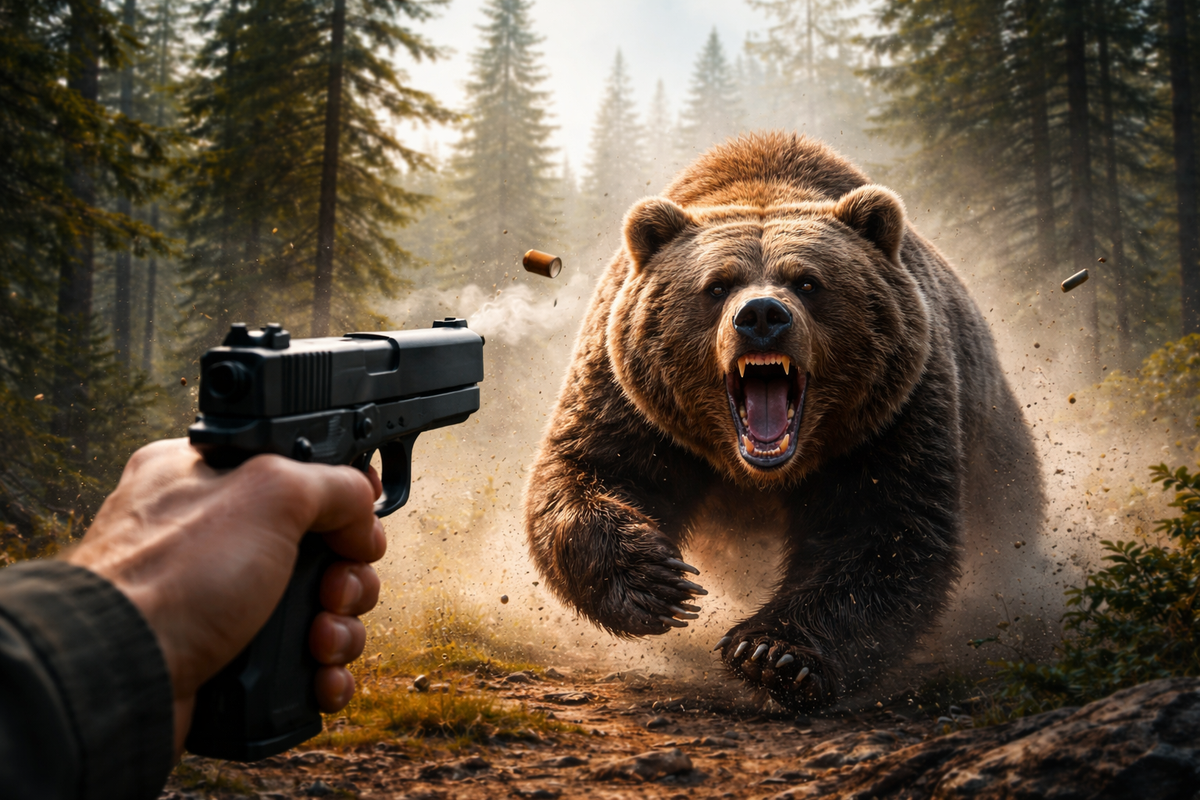
Can a 9mm Handgun Stop a Bear? Caliber Realities & Wilderness Defense Guide
Key Takeaways at a Glance
- Lethality vs. Stopping Power: While carrying a 9mm for bear defense can technically kill a bear, standard loads lack immediate stopping power against a aggressive charging predator.
- Ammunition Selection is Critical: Standard hollow points pancake against dense hides. Outdoor experts only recommend hard-cast 9mm bear defense ammunition for sufficient deep-tissue penetration.
- Proven Defense Alternatives: Statistical studies show that EPA-approved bear spray deterrents yield higher real-world success rates than handguns during encounters.
People often ask whether a 9mm handgun can stop a bear because it is one of the most popular and widely carried self-defense calibers in North America. Hikers, hunters, and campers frequently want to know if their everyday concealed-carry sidearm offers adequate protection in bear country when packing heavy, specialized handguns or long guns is not practical.
What Animals Can a 9mm Stop in the Wild?
A 9mm handgun is engineered for personal protection against human threats and is most effective against similarly sized targets. In real-world defensive contexts, its ability to stop wild animals depends on factors like shot placement, animal body mass, distance, and ammo velocity.
- Small Predators: Highly effective against coyotes, foxes, raccoons, and bobcats.
- Medium Wildlife: Can deter or neutralize feral dogs or cougars under optimal conditions with quick follow-up shots.
- Large & Dangerous Game: Deeply unreliable for stopping a charging grizzly bear, aggressive black bear, or large wild boar due to their thick bone density and muscle mass.
Ballistic Fact: Large predators possess heavy skeletal structures and intense adrenaline spikes. Lower-energy handgun calibers frequently fail to deliver immediate central nervous system shutdown before the animal reaches you.

Can a 9mm Kill or Stop a Bear? Lethality vs. Stopping Power
Understanding handgun calibers for bear country requires distinguishing between killing an animal (causing fatal organ bleeding over several minutes) and stopping a charge instantly. While a 9mm can kill a bear under precise conditions, it is not a recommended primary defense tool.
Will a 9mm Hollow Point Kill a Bear?
A 9mm hollow point can kill a bear under fortunate conditions, but it is not a dependable or recommended bullet type for bear safety. Hollow point ammunition (JHP) is designed to expand quickly in soft tissue, creating wide, shallow channels—ideal for personal defense, but ineffective against heavy wilderness threats.
Bears feature thick hides, dense muscle, and heavy fat layers. Hollow points expand too fast upon impact, failing to penetrate deeply enough to strike vital organs like the heart or lungs. For this reason, outdoorsmen choosing a 9mm for bear country avoid hollow points entirely, preferring non-expanding, heavy loads such as hard-cast 9mm bear defense ammunition or 147-grain FMJ +P rounds.
Would a 9mm Kill a Grizzly Bear?
A 9mm could theoretically kill a grizzly bear in extreme scenarios, but it is deeply unreliable for grizzly bear attack protection. Grizzly bears are massive land predators weighing up to 1,000 pounds, with heavy bone structures that act as physical armor against standard handgun rounds.
While isolated reports exist where shooters survived brown bear attacks using 9mm sidearms, these outcomes are highly situational and often rely on luck or non-predatory warning charges. Statistically, when evaluating performance against a determined predator, small-caliber handguns lack consistency.

9mm vs. Bear Skull: Skull Penetration Realities
Evaluating 9mm vs bear skull penetration reveals major physical limitations. A bear's skull is thick, highly sloped, and evolved to withstand massive physical impacts from rivals.
Defensive Risk: Bullets hitting a bear’s sloped skull at an angle during a fast-moving charge frequently glance off or fragment in outer tissue without penetrating the cranial vault.
Can a 9mm Puncture a Bear Skull?
In theoretical lab tests, a 9mm can puncture a bear skull at a direct perpendicular angle. However, in dynamic real-world charges, achieving the precise angle needed to penetrate the braincase is exceptionally difficult even for experienced marksmen.
How Many 9mm Bullets to Kill a Bear?
There is no set number of 9mm bullets required to neutralize a bear. While high-capacity semi-autos allow rapid firing, field reports confirm that multiple hits to non-vital areas will not halt a charging bear immediately. In extreme scenarios, emptying a full magazine (15+ rounds) may prove fatally delayed in stopping physical contact.
What Size Pistol Will Stop a Bear? (Caliber Comparison)
When selecting dedicated handgun calibers for bear country, outdoor experts recommend rounds capable of crushing bone and driving deep into tissue.
| Caliber Type | Average Muzzle Energy | Penetration Capability | Bear Defense Recommendation |
|---|---|---|---|
| 9mm Luger | ~350 - 450 ft-lbs | Low / Moderate (Hard-Cast Only) | Marginal / Last Resort |
| .45 ACP | ~400 - 500 ft-lbs | Moderate (Limited Velocity) | Sub-optimal |
| 10mm Auto | ~650 - 750 ft-lbs | Deep (Bone-Crushing Velocity) | Recommended (Semi-Auto) |
| .44 Magnum | ~1,000 - 1,200+ ft-lbs | Maximum Skeletal Penetration | Gold Standard (Revolver) |
Upgrading to robust options like 10mm Auto and .44 Magnum outdoor sidearms drastically increases your margin of safety when navigating predator-heavy backcountry trails.
Can a .45 Kill a Bear?
A .45 ACP can kill a bear under right conditions, but like the 9mm, it is sub-optimal for bear encounters. Although it fires a heavier bullet than a 9mm, its lower velocity limits deep penetration through thick muscle and dense bone compared to magnum cartridges.

Wilderness Safety Tips for Bear Encounters
Proper bear safety behaviors are far more effective than relying solely on firearms. Avoiding close-range encounters remains your best line of defense.
1. Do Not Run and Avoid Sudden Movements
Running triggers a bear's predatory chase response. Stand your ground, raise your arms to appear larger, and slowly back away while speaking in a calm, firm voice without making direct eye contact.
2. Manage Food Odors at Campsites
Prevent attracting wildlife by securing food and scented items in bear-resistant canisters or hanging them 10 feet off the ground and 4 feet from tree trunks.
3. Carry Bear Spray as Your Primary Deterrent
Field research confirms that EPA-approved bear spray deterrents achieve a 90%+ success rate in halting bear attacks. Bear spray creates an expanding cloud that disables the animal's eyes and respiratory system without requiring surgical aiming precision under stress.
4. Distinguish Defensive vs. Predatory Attacks
Defensive encounters occur when a bear is surprised or protecting cubs; backing away slowly or using spray works best. Predatory encounters are rare, where a bear silently stalks you—in this scenario, stand your ground and fight back aggressively with every tool available.
Conclusion
While a 9mm handgun is reliable for urban defense, it remains a high-risk, marginal choice for stopping bears. Its physical limits against thick hide and dense bone mean quick stopping power is never guaranteed. If you carry a 9mm in the wild, load specialized hard-cast bullets, but prioritize non-lethal deterrents like bear spray for maximum safety.



Share:
RMR vs RMSc Footprint: Are RMR and RMSc Footprints the Same?
Precision in the Field: Best PCP Setups for Effective Urban Pest Control