

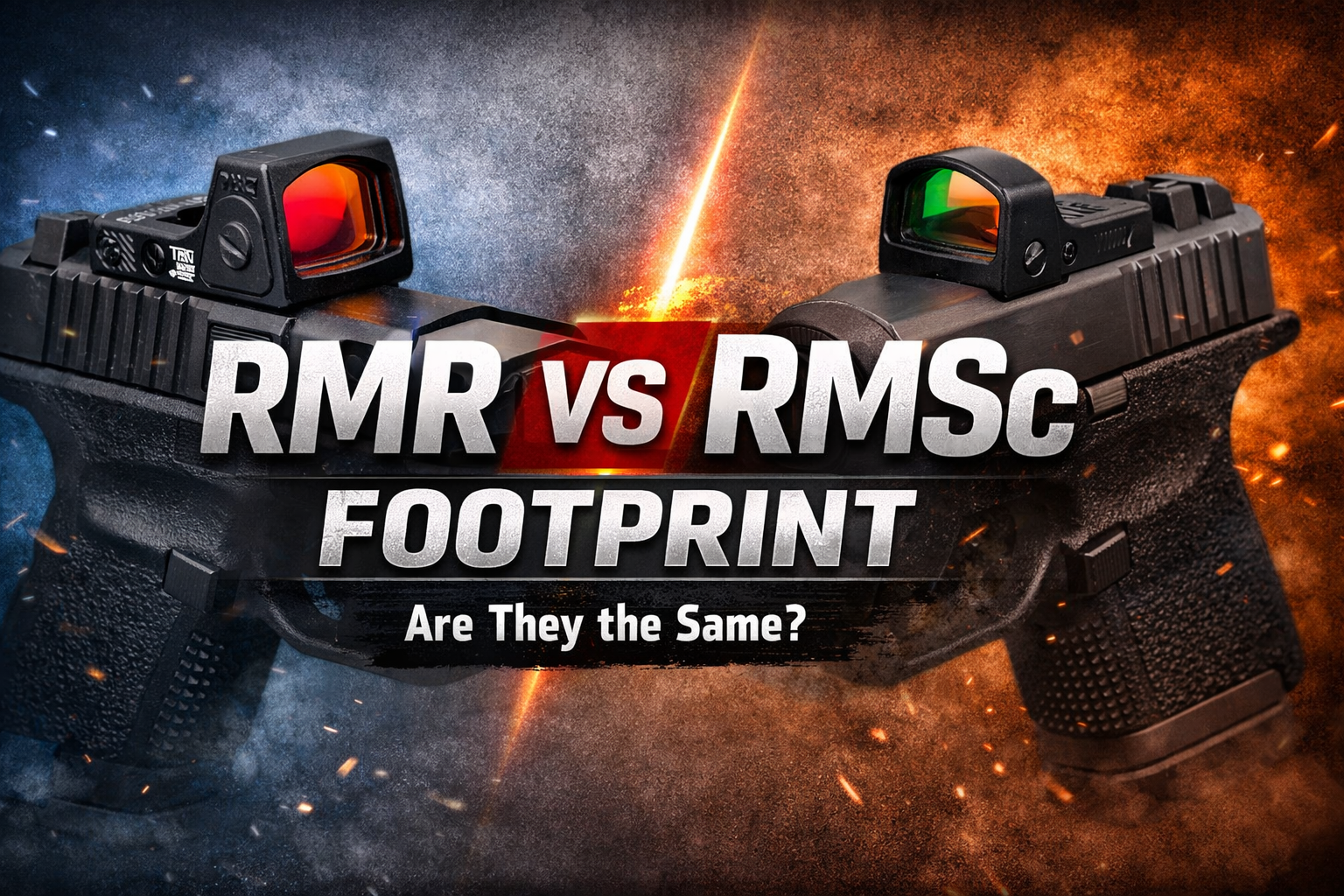
The RMR and RMSc footprints are two of the most common red dot mounting standards used on pistol slides, but they are often confused because they serve similar purposes. The RMR footprint is designed for full-size, duty-grade optics, while the RMSc footprint is built for smaller, micro-compact pistols intended for concealed carry. Although both systems allow red dot sights to be mounted securely to handguns, they are not the same and are not directly interchangeable.
What is an RMSc footprint?

The RMSc footprint is a standardized mounting pattern used for attaching micro red dot sights to pistol slides, especially compact and subcompact handguns.
It was originally developed around the Shield RMSc optic from Shield Sights, and has since become one of the most widely adopted micro-optic mounting standards in the concealed carry and compact pistol market.
This footprint defines the exact size, screw hole locations, and recoil lug positions needed to securely mount an optic. Compared to larger systems like the RMR footprint, the RMSc design is smaller and more streamlined, allowing optics to sit lower on slim pistol slides. This helps maintain a more natural sight picture and reduces bulk, which is particularly important for everyday carry firearms.
In practical terms, an RMSc-cut slide allows users to mount compatible optics directly without additional machining or complex mounting systems. This makes it a popular choice for concealed carry pistols, where low profile, lightweight design, and quick optic installation are key priorities.
What is a RMR footprint?

The RMR footprint is a widely used standardized mounting pattern for attaching red dot sights to pistol slides. It is based on the design of the Trijicon RMR optic from Trijicon RMR, which set the industry standard for durable, duty-grade handgun optics.
This footprint defines the exact screw hole spacing, recoil lug placement, and mounting interface so that different optics can be installed on compatible slides without custom fitting.
Compared to smaller micro-optic standards like RMSc, the RMR footprint is larger and more robust. It is designed to handle heavier recoil and is commonly used on full-size and duty pistols.
The mounting system typically includes two front recoil posts (or lugs) and two rear mounting screws, which help keep the optic securely in place under hard use conditions such as tactical training, competition shooting, or law enforcement duty.
In short, the RMR footprint is the “heavy-duty” standard for red dot mounting, offering strength, stability, and broad compatibility across a wide range of pistol platforms.
RMR vs RMSc Footprint: Are RMR and RMSc Footprints the Same?

No — RMR and RMSc footprints are not the same. They are two completely different red dot mounting standards designed for different sizes of pistols and optics.
RMR vs RMSc Footprint: Key Differences
|
Category |
RMR Footprint |
RMSc Footprint |
|
Size |
Large, designed for full-size optics |
Small, designed for micro-compact optics |
|
Primary Use |
Duty, tactical, competition pistols |
Concealed carry, slim subcompact pistols |
|
Original Standard |
Based on Trijicon RMR |
Based on Shield Sights RMSc |
|
Mounting Style |
Wider base with robust recoil lug system |
Compact design with smaller lug + rear screw setup |
|
Slide Cut Size |
Larger optic-ready slide cut |
Narrow, low-profile slide cut |
|
Typical Optics Size |
Larger window, heavier optics |
Smaller, lightweight micro red dots |
|
Common Pistols |
Glock 19/17, duty-sized handguns |
SIG P365 series, Hellcat, Shield Plus, Glock 43X MOS (plate system) |
|
Compatibility |
Not compatible with RMSc without adapters |
Not compatible with RMR without adapters |
|
Durability Focus |
High durability for duty use |
Lightweight and concealment-focused |
|
Example Optics |
Trijicon RMR / SRO, Holosun 507C/508T |
Shield RMSc, Holosun 407K/507K (K-series), Sentinel |
The RMR footprint (based on the Trijicon RMR from Trijicon RMR) is a full-size, duty-grade mounting standard. It uses a wider base, larger screw spacing, and stronger recoil lug design to support heavier optics with larger windows. It is commonly found on full-size and combat/duty pistols like Glock 19/17-size platforms.
The RMSc footprint, originally developed by Shield Sights, is a micro-compact mounting standard designed for slim, concealed-carry pistols. It is significantly smaller, with tighter screw spacing and a compact recoil lug system that allows low-profile mounting on subcompact slides like the SIG P365 or Glock 43X MOS.
RMR vs RMSc Footprint: Will RMR fit on RMSc?
No — an RMR footprint will NOT fit on an RMSc slide cut. They are completely different mounting systems and are not interchangeable.
The RMR footprint (Trijicon RMR / SRO pattern) is larger, wider, and designed for full-size optics. It uses a broader mounting base and different recoil lug spacing compared to RMSc. The RMSc footprint is a micro-compact standard, built for slim carry pistols, and the slide cut is physically much smaller.
Because of this size and geometry difference:
-
An RMR optic is too large to sit on an RMSc-cut slide
-
The screw holes and recoil lugs do not line up
-
You would need a purpose-built adapter plate, and in most cases even that is not practical due to height and structural mismatch
In real-world terms, RMSc slides (like SIG P365, Hellcat, Shield Plus) are designed for micro dots, while RMR optics are designed for larger duty pistols like Glock 19/17 size platforms.
DPP vs RMSc Footprint: Is DPP Footprint the Same as RMSc?
The DPP footprint (DeltaPoint Pro footprint) and the RMSc footprint are two completely different red dot mounting standards designed for different size optics and slide cuts.
|
Category |
RMSc Footprint |
DPP Footprint |
|
Size |
Small, designed for micro-compact pistols |
Large, designed for duty and full-size optics |
|
Compatibility |
RMSc optics will NOT fit DPP cuts without adapters |
DPP optics are physically too large for RMSc slides |
|
Mounting Style |
Compact rear screw setup with small recoil lug system |
Wider base with 4 corner-style recoil lugs for added stability |
|
Typical Use Cases |
Concealed carry, slim pistols (e.g., Hellcat, P365, Shield) |
Full-size pistols, competition shooting, duty/defensive guns |
The RMSc footprint is a micro-compact standard originally developed by Shield Sights. It is used mainly on slim, concealed-carry pistols. It has a smaller mounting area and typically uses a compact pattern with screw holes at the rear and small recoil lugs designed for low-profile optics. It is optimized for subcompact slides like the SIG P365 series or Glock slimline models.
The DPP footprint, on the other hand, comes from the Leupold DeltaPoint Pro system and is a larger, full-size mounting standard. It uses a wider base with four recoil lugs positioned near the corners of the optic and is designed for bigger, duty-style red dots with larger windows and more rugged construction.
RMSc vs K Footprint
The RMSc vs K footprint comparison is one of the most confusing topics in red dot mounting because they look similar but are not fully interchangeable.
The RMSc footprint comes from the original Shield RMSc standard developed by Shield Sights. It is a true micro-compact mounting system designed for slim concealed-carry pistols. It typically uses four recoil lugs (two front + two rear) along with rear screw mounting holes. This gives a very secure lockup on slides like the SIG P365 or Hellcat.
The K footprint, used by Holosun (such as 407K, 507K, EPS Carry), is a modified version of RMSc, but not identical. It removes the rear recoil lugs and uses only two front lugs with shallower engagement points. This simplifies manufacturing and improves compatibility with some slide cuts, but it changes the geometry enough that it is no longer a true RMSc pattern.
RMSc Footprint to RMR Adapter
An RMSc-to-RMR adapter is a mounting plate that lets you install a larger RMR footprint optic (like a Trijicon RMR or Holosun 507C) onto a slide that was originally cut for the smaller RMSc footprint.
These adapters exist because the RMSc footprint is physically smaller and uses different lug geometry, so an RMR optic will not fit directly. The adapter plate sits in the RMSc slide cut and “converts” it into an RMR-compatible mounting surface, usually by providing a new base with the correct screw spacing and recoil lug positions for RMR optics.
In practice, the plate is bolted onto the RMSc-cut slide first, and then the RMR optic is mounted on top of the plate. This allows compatibility with popular full-size optics like the Trijicon RMR / SRO and Holosun 407C / 507C series without needing to mill a new slide cut.
However, there are trade-offs. Adding an adapter increases the overall height of the optic, which can affect your sight picture and usually requires suppressor-height iron sights if you want co-witnessing. It also introduces an additional mounting interface, which means one more layer of screws that must be properly torqued and secured with thread locker to maintain reliability.
FAQs
What pistols use the RMSc footprint?
The RMSc footprint is most commonly found on micro-compact and concealed carry pistols, especially those designed for slim, everyday-carry red dots. It has become a de facto standard for this size category, particularly for “slimline” or subcompact slides.
One of the most well-known examples is the Springfield Armory Hellcat OSP, which is designed around an RMSc-style optic cut for direct mounting of micro red dots. Similarly, the Smith & Wesson M&P Shield Plus Optics Ready models use an RMSc footprint, making them one of the most popular platforms in this category.
Will RMSc fit on the K footprint?
No — an RMSc optic will not properly fit a K footprint slide cut in most cases, because even though the two systems are closely related, they are not identical.
The RMSc footprint (from Shield Sights) uses a full set of recoil lug interfaces including rear lugs, while the Holosun K footprint (used on models like the 407K and 507K) removes those rear lugs and only uses front lug positions.
This means an RMSc optic will usually have rear lug points that physically interfere with a K-cut slide, preventing it from sitting flush or aligning correctly with the mounting screws.
What optics fit the RMSc footprint?
Many modern micro red dot sights are designed around or adapted to the RMSc footprint. Examples include the Shield RMSc itself, Holosun 407K and 507K models (with RMSc-compatible mounting), Swampfox Sentinel, and similar compact optics. While some optics are not directly RMSc, they may still fit with minor modifications or adapter plates depending on the slide cut.
What optics fit the RMR footprint?
The RMR footprint is one of the most widely supported red dot mounting standards, and a large number of pistol optics are designed to fit it directly without adapters.
The most well-known are from Trijicon RMR itself, including the RMR Type 1 / Type 2 and the larger-window Trijicon SRO, both of which are original RMR-footprint optics and set the standard for this mounting pattern.
Many other manufacturers also build optics directly compatible with the RMR footprint. A very popular group comes from Holosun, including models like the 407C, 507C, 508T, and 507 Competition series. These are widely used because they offer similar durability and compatibility while adding different reticle and battery features.
What optics fit the DPP footprint?
The DPP footprint (DeltaPoint Pro footprint) is used by a fairly wide range of full-size and duty-style red dot optics. The original optic is the Leupold DeltaPoint Pro, which is the reference design for this mounting standard.
Many modern optics from other brands also use the same footprint or are designed to be directly compatible. A popular group includes the Vortex Defender ST and Vortex Defender XL, both of which are widely supported on DPP-cut slides.
Is the Holosun 507K a RMSc footprint?
No — the Holosun 507K does NOT use a true RMSc footprint, even though it is often described that way in casual terms.
The 507K uses a Holosun “K-series” footprint, which is a modified version of the Shield RMSc pattern, not a direct match. It is similar enough that people often group them together, but the mounting geometry is not identical.
The key difference is in the recoil lug and screw layout. The RMSc footprint (from Shield Sights) has a different lug arrangement, while the 507K removes and reshapes some of those interfaces. Because of this, a slide cut specifically for RMSc will usually not accept a 507K directly without modification or an adapter plate, depending on the exact manufacturer.




Share:
What Is an RMR Footprint?
Will a 9mm Stop a Bear? Facts, Risks & Effectiveness Explained