

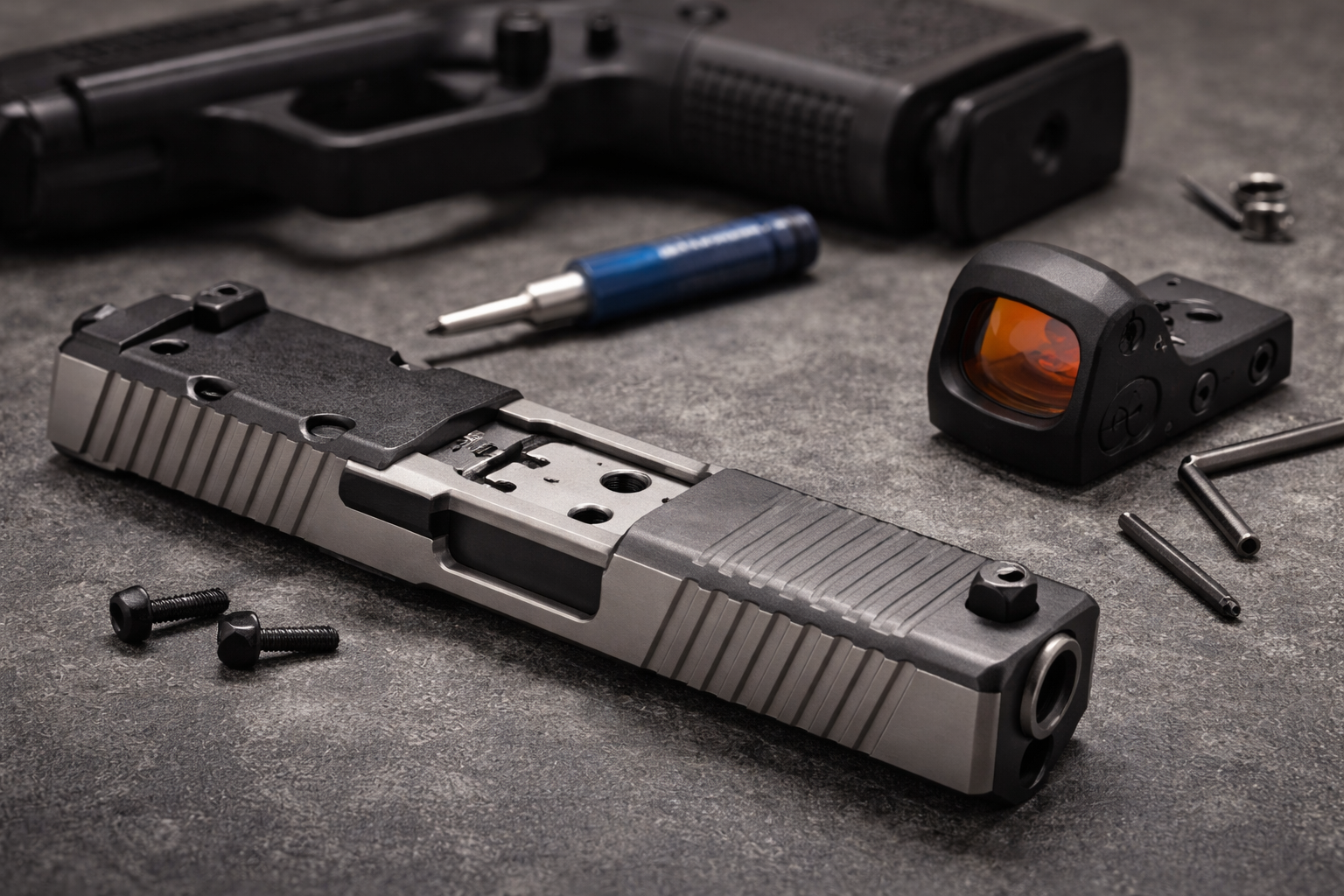
An RMR footprint is a standardized mounting pattern used for attaching red dot sights to pistol slides, originally based on the design of the Trijicon RMR. It has become one of the most widely adopted optics mounting standards in the handgun industry because of its strength, reliability, and compatibility across many modern pistol platforms. When a slide or optic is described as having an “RMR footprint,” it means it follows this specific mounting interface, allowing for secure and repeatable installation of compatible red dot sights.
What Is an RMR Footprint?
An RMR footprint is a standardized mounting pattern used for attaching red dot sights to pistol slides. It was originally developed around the Trijicon RMR, which became one of the most influential pistol optics in the industry. Because of its popularity and reliability, many manufacturers adopted the same mounting interface, turning it into a widely used standard.
The footprint itself refers to the physical interface between the optic and the slide. It includes two screw holes with a specific spacing, along with recoil lugs or locating bosses that help keep the optic securely in place under recoil. These features ensure that the sight remains stable and does not shift during repeated firing, which is especially important for handguns.
When a pistol slide is described as having an RMR cut or RMR footprint, it means it is machined to accept optics that match this mounting standard. This allows shooters to directly mount compatible red dot sights without needing additional adapter plates, making installation simpler and more secure.
Today, many modern pistol optics use this footprint or a variation of it, which is why it has become a common compatibility reference in the optics world. However, small differences can still exist between manufacturers, so it is always important to verify whether a specific optic is truly direct-mount compatible with a given slide cut.
RMR vs Doctor vs RMSc Footprints

The RMR, Docter, and RMSc footprints are three different mounting standards for pistol red dot sights, and they are not interchangeable without plates or specific slide cuts. The main differences come down to size, screw spacing, and the type of pistols they’re designed for.
The RMR footprint, originally designed around the Trijicon RMR, is the most widely used modern standard. It is built for full-size and compact pistols, with a strong mounting interface that includes two screws and recoil lugs. Because of its durability and popularity, many optics like Holosun’s full-size series use this footprint or close variants of it. It is generally considered the most robust of the three.
The Docter/Noblex footprint (often just called “Docter footprint”) is an older standard originally used by Docter Optics / Noblex-style sights. It has a different screw spacing and a simpler mounting design compared to RMR. While it is still supported on some pistols and optics, it is less common today. Some slide manufacturers still offer Docter cuts because older optics or certain budget-friendly sights use it, but it has largely been overshadowed by RMR and RMSc systems.
The RMSc footprint is the smallest of the three and is designed specifically for micro-compact, slim carry pistols. It is used on optics intended for concealed carry guns where slide width is limited. RMSc mounts are much more compact than RMR, which allows them to fit narrow slides without overhang. However, this also means they are structurally smaller and generally used with smaller optics.
RMR vs RMSc Footprint: Are RMR and RMSc Footprints the Same?
RMR a vs RMR B Footprint
“RMR A” and “RMR B” are not true universal industry footprint standards like RMR vs RMSc. Instead, they are manufacturer-specific labeling systems, most commonly seen in Holosun optics and mounting plates, to describe slight variations of the RMR mounting interface.
In general usage, RMR-A usually refers to an RMR-style footprint with a simplified or modified lug arrangement, often meaning it follows the basic Trijicon RMR screw pattern but may not use the full set of recoil lug interfaces found on a standard RMR-cut slide. This type of setup is sometimes used for optics that rely more on screw tension and a simplified mounting base.
RMR-B, on the other hand, typically refers to a full RMR footprint configuration, meaning it more closely matches the original Trijicon RMR standard. This includes the standard screw spacing plus full recoil lug engagement, making it more secure and better suited for heavier recoil or duty use.
The key point is that “A vs B” is not a universal standard across all brands or slides. One company’s “RMR-A” may not match another company’s definition, which is why compatibility charts from the optic or slide manufacturer matter more than the label itself.
RMR Footprint Dimensions (standard specs)

The RMR footprint dimensions refer to the exact spacing and layout of the mounting interface originally designed around the Trijicon RMR. While different manufacturers may vary slightly in machining, the RMR footprint has become a widely adopted industry standard for pistol optics.
The main structural elements are two front recoil-lug sockets and two central screw holes:
-
Front lug spacing: ~22.5 mm (0.89 in) center-to-center
-
Front-to-rear layout length: ~22.3 mm (0.88 in) between lug area and screw area
-
Screw hole spacing: ~18.8 mm (0.74 in) center-to-center
-
Overall optic base footprint (approx.): ~45.7 mm × 24.1 mm (1.8 in × 0.95 in)
What these dimensions mean in practice
The front sockets engage recoil posts on the slide or mounting plate, preventing the optic from shifting under recoil. The two screws in the center secure the optic down to the slide or adapter plate. Together, this creates a very strong and repeatable mounting system that is ideal for defensive and duty pistols.
Conclusion
RMR footprint is a durable and widely used mounting standard that has shaped the modern pistol optics market. Its design provides a strong, recoil-resistant platform for red dot sights, making it a preferred choice for both defensive and professional use. Understanding this footprint is essential when selecting optics or slides, as it ensures proper compatibility and optimal performance.
FAQs
What is the RMSc footprint?
The RMSc footprint (often called the Shield RMSc footprint) is a standardized mounting pattern used for micro red dot sights on slim, compact pistols. It was originally developed by Shield Sights for their RMSc optic line and has since become one of the most widely used standards for concealed-carry handgun optics.
The RMSc footprint is designed specifically for narrow-slide pistols, where a full-size mounting system like the RMR footprint would be too large. It uses a smaller mounting base with rear screw holes and recoil lug sockets arranged in a compact layout. This allows the optic to sit lower and fit neatly on subcompact and single-stack style pistols.
Because of its compact size, the RMSc footprint is commonly found on optics designed for everyday carry guns, including many micro-red-dot models from various manufacturers. While some optics are fully RMSc-compatible, others (like certain Holosun “K-series” models) use a slightly modified version of the footprint, which can still fit many RMSc-cut slides but may not always be perfectly interchangeable.
What pistols use an RMR footprint?
Pistols that use an RMR footprint are typically full-size and compact handguns that are either optics-ready from the factory or have slides milled for red dot sights. The footprint is based on the Trijicon RMR, which has become a common standard for duty-style optics.
Many modern pistol platforms now ship with “RMR-cut” or “RMR-compatible” slides, especially in service and tactical models. These include popular full-size pistols like the Glock 17 MOS series, Glock 19 MOS series (with RMR plates or direct cuts depending on generation), SIG Sauer P320 optics-ready models, Smith & Wesson M&P 2.0 Optics Ready series, and FN 509 Tactical. These pistols are often designed to accept RMR footprint optics either directly or through factory mounting plates.
In addition to factory optics-ready guns, many pistols are custom-milled by aftermarket shops specifically for the RMR footprint. This is extremely common for concealed carry and duty pistols because the RMR pattern is strong, widely supported, and compatible with many popular red dot sights from brands like Holosun and Trijicon.
Is RMR the same as RMSc?
No, RMR and RMSc are not the same, and they are not directly compatible.
The RMR footprint is based on the Trijicon RMR and is designed for full-size and compact pistols. It uses a larger mounting base with wider screw spacing and stronger recoil lug support. This makes it suitable for duty pistols, defensive handguns, and optics that need to withstand heavier recoil and more demanding use.
The RMSc footprint, on the other hand, is designed for micro-compact and slim carry pistols. It is smaller and more compact, allowing it to fit narrow slides such as those found on concealed carry handguns. Because of its reduced size, it uses a different screw spacing and mounting layout compared to RMR.
What does a RMR footprint look like?
An RMR footprint is the mounting pattern used on pistol slides and optics that is based on the design of the Trijicon RMR. Visually, it appears as a rectangular milled pocket on the top of a slide, with two central screw holes for securing the optic and two front recoil lug cutouts that help lock the sight in place and prevent movement under recoil. This layout is wider and more robust than micro optic cuts, allowing the red dot to sit low on the slide while maintaining strong structural support.
Can a red dot sight be used with astigmatism?
Yes, a red dot sight can still be used if you have astigmatism, but the dot may not look perfectly crisp.
Astigmatism is a common vision condition where the eye doesn’t focus light evenly, so instead of seeing a sharp dot, you might see the reticle as blurred, smeared, starburst-shaped, or like a cluster of dots. This is especially noticeable with red dot sights because they project a single illuminated point of light.
Even though the dot may look distorted, many shooters with astigmatism can still use red dots effectively. The key is that the point of impact is still accurate, even if the dot doesn’t look perfect. Your brain often learns to “ignore” the distortion and use the center of the blur as the aiming point.
There are also ways to improve clarity. Trying a different brightness setting (usually lower is better), using a different dot color, or choosing a larger MOA dot can sometimes help. Some people find that prism scopes or etched reticle optics work better because the reticle is physically engraved rather than projected as light.
Share:
How to Choose a PCP Air Rifle for Coyote Hunting
RMR vs RMSc Footprint: Are RMR and RMSc Footprints the Same?